
Table of Contents
- What Fair Trade Coffee Actually Promises
- How Fair Trade Coffee Certification Works
- Farmer Income, Working Conditions, and Child Labor Protections
- Organic Fair Trade Coffee: Where the Two Labels Overlap
- How Much of Your Money Reaches the Farmer
- Fair Trade Coffee Brands and How to Read Their Labels
- How to Choose Fair Trade Coffee You Will Actually Enjoy
- Frequently Asked Questions
Last Updated: October 14, 2026
What Fair Trade Coffee Actually Promises
Fair trade coffee is a certification system that guarantees a minimum price for growers, a social premium paid on top of that price, and a set of labor and environmental standards that producers must meet to sell under the label. At Gilded Grind, we source beans from cooperatives that carry this certification.
The promise rests on two mechanisms working together: a price floor that protects farmers when the market collapses, and a premium that funds community projects. Neither guarantees wealth. Both reduce the worst outcomes.
The minimum price and the premium, explained
The minimum price is the floor a buyer must pay a certified cooperative when the commodity market drops below it. The social premium is a separate amount paid on top of the purchase price, controlled by the cooperative itself rather than by any individual farmer. Producer organizations typically vote on how to spend it: schools, processing equipment, training, or healthcare.
That structure matters because it shifts a small amount of power from the buyer to the growers. A cooperative that controls its own premium money makes decisions a single smallholder farmer could never make alone.
How Fair Trade Coffee Certification Works
Certification runs through an independent third-party body that inspects producers, exporters, and traders against a published standard. Fairtrade International sets the global standard, and in North America the mark is licensed and audited through Fairtrade America's certification process. Growers apply as cooperatives or associations rather than as individuals, which keeps the audit load manageable.
Who gets certified, and who checks
Smallholder farmers organized into producer organizations form the base of the system. The certifier reviews labor practices, chemical handling, record-keeping, and democratic governance within the cooperative. Traders and importers are checked separately to confirm they actually paid the floor price and the premium.
What most guides miss is that certification is a chain obligation, not a farm badge.
- Producers: must be organized, democratic, and audited annually
- Importers and traders: must document price and premium payments
- Brands: must hold a licensing agreement to print the mark
- Independent auditors: verify each link separately
Farmer Income, Working Conditions, and Child Labor Protections
Certified standards prohibit forced labor and set rules against child labor, with the strongest enforcement aimed at keeping children in school rather than in fields. The standards also require safe handling of agrochemicals, protective equipment where chemicals are used, and freedom of association so workers can organize.
On income, the honest answer is that certification raises the floor, not the ceiling. A cooperative that sells only into the certified market earns a predictable but modest amount. Cooperatives that also sell into specialty markets, where buyers pay well above the floor for quality, do considerably better. That is why the best outcomes tend to come from farms that pair certification with quality improvement.
What the evidence actually shows
Most public claims about fair trade income effects are broader than the research supports. A common pattern in independent studies is that certification produces modest, positive gains for organized cooperatives, better price stability, more access to credit, and small improvements in household income, while effects on individual smallholders who are not well organized are weaker and harder to measure. Two caveats matter:
- Certification costs (inspection fees, record-keeping, cooperative administration) can be a real barrier for the smallest farms, and some producers never recoup them.
- Audits verify process, that a price was paid, that a rule was followed, more reliably than they verify outcomes like household income or school enrollment.
That is not an argument against certification. It is an argument for reading impact claims carefully and treating certification as one lever among several, not a complete solution.
Where the money goes
The grower's share of a retail bag is a minor portion of the total, and the certification premium is a smaller fraction still. Between grower and cup sit export, shipping, import, storage, and retail margin, and each step takes a cut. Certification does not restructure that chain; it sets a floor within it. The counterargument is that a floor with a premium beats no floor at all, and that cooperatives with strong governance reinvest more than the raw percentage suggests.
Other limitations worth knowing:
- Certification costs can exclude the smallest farms
- Audits verify process, not always outcomes
- The mark says nothing about flavor quality
- Some certified volume is sold uncertified when demand is soft
Organic Fair Trade Coffee: Where the Two Labels Overlap
Organic fair trade coffee carries two separate certifications that address different things. Organic covers how the crop is grown: no prohibited synthetic inputs, buffer zones against conventional farms, and documented soil management. Fair trade covers how the people are treated and paid. A bag can legitimately carry one without the other.
When both marks appear together, as they do on our Peru Cajamarca FTO Medium-Dark, you are looking at a farm that met environmental rules and labor rules at once. The overlap is not automatic, and that distinction trips up a lot of shoppers.
| Label | What it covers | What it does not cover |
|---|---|---|
| Fair trade | Minimum price, premium, labor standards | Growing methods, input rules |
| Organic | Soil, inputs, buffer zones | Farmer pay, labor conditions |
| Both marks | Price floor plus environmental rules | Quality grade, flavor profile |
How Much of Your Money Reaches the Farmer
The short answer: a small fraction of retail, and the certification premium is a smaller fraction still. Between grower and cup sit export, shipping, import, storage, and retail margin. Each step takes a cut, and the grower's share of a bag sold at retail is typically a minor portion of the total.
Peru Cajamarca FTO | Medium-Dark →
That is the strongest criticism of the model, and it is fair. Certification does not restructure the supply chain; it sets a floor within it. The counterargument is that a floor with a premium beats no floor at all, and that cooperatives with strong governance reinvest more than the raw percentage suggests.
Other limitations worth knowing:
- Certification costs can exclude the smallest farms
- Audits verify process, not always outcomes
- The mark says nothing about flavor quality
- Some certified volume is sold uncertified when demand is soft
Fair Trade Coffee Brands and How to Read Their Labels
Reading a label takes about thirty seconds once you know what to look for, but the words on the front of a bag are marketing, not certification. The mark itself is the only part that carries an audit behind it. Everything else, "ethically sourced," "direct trade," "farmer friendly", is a claim the business is making about itself, and none of those phrases has a shared standard or an independent inspection.
Step 1: Find the actual mark
Look for a recognized certification logo, not a lookalike. Fairtrade International's mark is the most widely used; other credible certifiers operate their own marks. A logo that resembles a certification but is not one is a red flag, and so is a bag that uses the words "fair trade" with no mark at all.
Step 2: Check what the mark covers
Different certifiers and standards cover different things. Some focus on price and premium; others emphasize labor, environment, or both. The mark tells you which standard was applied, and the certifier's own website lists what that standard requires. If a bag carries two marks, say, fair trade and organic, each one covers a separate set of rules, and neither substitutes for the other.
Step 3: Look for named origin and traceability
A business that names the cooperative, region, or washing station is showing you where the beans came from. A bag that says only "fair trade coffee" with no origin is technically compliant but tells you almost nothing. Traceability is not the same as certification, but the two together are a much stronger signal than either alone.
Step 4: Check the date, not just the logo
Certification says nothing about freshness. Coffee is an agricultural product, and a certified bean from two years ago is still a two-year-old bean.
- Certifier mark present and current, not a lookalike
- Named cooperative, region, or washing station
- Harvest or roast date printed, not just a best-before
- Certification named specifically: fair trade, organic, or both
- No vague ethical language standing in for a mark
How to Choose Fair Trade Coffee You Will Actually Enjoy
Choosing well comes down to matching the origin and roast level to flavors you already like, then confirming the certification details. The label tells you how the coffee was produced. The origin and roast tell you how it will taste.
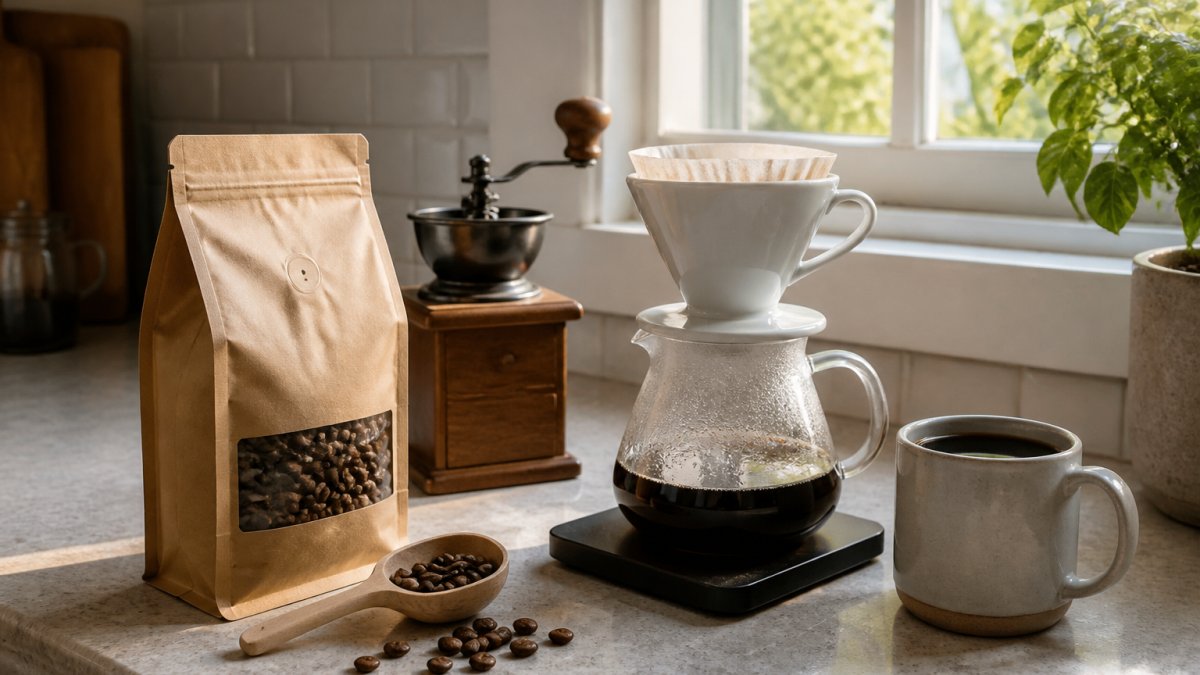
Start with what is already in your cup. If you drink dark, syrupy coffee, an earthy Indonesian bean will feel familiar. If you like tea and citrus, a light Ethiopian roast will land better.
Match the origin to the flavor you already like
- Earthy and rich: our Sumatra G1 Organic, wet-hulled for depth with dark chocolate and a smoky finish
- Balanced and sweet: our Peru Cajamarca FTO, with stone fruit, honey, and raisin
- Floral and bright: our Yirgacheffe Ethiopia, with jasmine, rose, and orange zest
- Delicate and tea-like: our Limu Ethiopia Light Roast, with floral and green tea notes
Store the bag sealed, away from light and heat, and buy in quantities you will finish within a few weeks rather than months.

Fair trade coffee gives you a verifiable way to know that the people who grew your beans were paid a floor price and that their cooperative received a premium it controls. It is not a complete answer to inequality in the supply chain, but it is a real one you can act on today. At Gilded Grind, we source certified single-origin beans, name the region on every bag, and offer roast profiles from light to dark so you can match the cup to your own taste.
Frequently Asked Questions
What is the definition of fair trade coffee?
Fair trade coffee is coffee bought under a certification system that sets a minimum price for growers, adds a fixed premium on top, and requires buyers to work with farmer-owned cooperatives rather than anonymous middlemen. The standards also cover working conditions, bans on child labor, and limits on certain chemicals. In practice, a bag carrying a fair trade mark means the beans passed an independent audit against those rules, not that every step of the supply chain was inspected in person.
Is fair trade coffee always organic?
No. They are separate certifications with separate audits. A coffee can be fair trade without being organic, and organic without being fair trade. Some bags carry both marks, and those are usually the ones worth looking for if you care about environmental standards as well as farmer income. When a bag shows only one mark, read the fine print to see which set of rules it actually meets.
Does fair trade coffee taste different?
The certification does not change how coffee tastes. Flavor comes from origin, variety, not from the label. A washed Peruvian coffee will taste clean and sweet whether or not it is certified. What the label does affect is how the coffee was grown and what the farmer was paid. Judge the cup on origin and processing, and judge the ethics on the certification.
How can I tell if coffee is fairly traded?
Look for a recognized certification mark on the packaging, then check whether the business names the cooperative or region the beans came from. A mark alone tells you the minimum price and premium rules were followed. A named cooperative with published sourcing details tells you the business knows its supply chain. If a bag uses vague phrases like ethically sourced with no mark and no origin detail, treat that as marketing rather than proof.


