
Table of Contents
- What Separates Professional Coffee From Ordinary Brews
- The Best Coffee Brewing Equipment for Home Baristas
- The Ideal Coffee to Water Ratio for Consistent Results
- Coffee Brewing Temperature Guide: Why Degrees Matter
- Step-by-Step: Brewing Professional Coffee at Home
- How to Store Premium Coffee Beans for Lasting Freshness
- Measuring TDS and Extraction Yield: The Barista's Secret
- Common Mistakes That Ruin Professional Coffee at Home
- Frequently Asked Questions
Last Updated: September 10, 2026
What Separates Professional Coffee From Ordinary Brews
Professional coffee is the result of controlling four variables: grind size, water temperature, coffee-to-water ratio, and brew time. Get those right, and a home setup can match what a good café serves. Miss them, and even expensive beans taste flat.
The gap usually isn't equipment; it's measurement. Most home brewers eyeball their grounds and guess at water temperature, which is why results swing from cup to cup. This guide from Gilded Grind walks through the ratios, temperatures, and techniques that make professional coffee reproducible at home, plus the troubleshooting steps that fix a bitter or sour cup.
Below, we'll show you exactly how to dial in each variable, from a basic pour-over to a full extraction reading.
The Best Coffee Brewing Equipment for Home Baristas
The best coffee brewing equipment for home starts with three items: a burr grinder, a gooseneck kettle, and a digital scale. Those three matter more than any single brewing device because they control grind consistency, pour precision, and dose accuracy. Get them right, and a $30 dripper can outperform a $300 machine fed by poor tools.
Essential Tools That Make the Biggest Difference
- Burr grinder - produces uniform particles, which prevents channeling and uneven extraction
- Gooseneck kettle - gives you a slow, controlled pour for even saturation
- Digital scale - measures coffee and water in grams, not scoops; a 0.1-gram resolution is ideal
- Timer - tracks brew time so you can repeat a good result
- Filter paper or metal filter - matched to your brewing method
Budget-Friendly vs. Pro-Grade Gear: What to Prioritize
Not every upgrade changes the cup. Here's where the money actually matters.
Spend here: the grinder. This is the single highest-impact purchase. A blade grinder produces a mix of powder and boulders, so some grounds over-extract while others stay raw, and no amount of technique fixes it. A burr grinder with conical or flat steel burrs delivers a consistent particle size, which is the foundation every other variable sits on. Entry-level hand burr grinders start around $40-$60; a solid electric burr grinder runs $100-$200 and will outlast several brewers.
Spend moderately: the scale. A basic 0.1-gram kitchen scale costs $15-$25 and does everything a home brewer needs. Bluetooth scales that log your pour rate are a luxury, not a requirement.
Save here: the kettle. Any kettle with a narrow, curved spout gives you pour control. A variable-temperature model is convenient but not essential if you already own a thermometer and can rest boiled water for 30 seconds. A $25 stovetop gooseneck works nearly as well as a $150 electric one.
Save here: the brewer. Pour-over drippers, French presses, and AeroPress-style devices are simple and cheap. A plastic V60-style cone costs a fraction of a ceramic or glass version and brews identically. There is no meaningful flavor difference between a $15 dripper and a $60 one.
Where the Money Actually Changes the Cup
Ranked by impact per dollar: grinder first, then water quality, then scale, then everything else. A home brewer working with a good burr grinder, filtered water with the right mineral balance, and an accurate scale has already closed most of the gap to a café. The remaining equipment is largely about convenience and repeatability, not flavor.
The Ideal Coffee to Water Ratio for Consistent Results
The ideal coffee to water ratio is 1:15 to 1:17 by weight for most methods, meaning one gram of coffee to 15-17 grams of water (peer-reviewed research). Start at 1:16, then adjust toward 1:15 for a stronger cup or 1:17 for a lighter one.
Weigh both. A scoop of coffee varies widely depending on grind and bean density, so volume measurements drift. For a single 300-gram cup, that's roughly 19 grams of coffee.
| Method | Coffee : Water | Grind Size | Target Brew Time |
|---|---|---|---|
| Pour-over | 1:16 | Medium-fine | 2:30-3:30 |
| French press | 1:15 | Medium-coarse | 4:00 |
| Drip machine | 1:16 | Medium | 5:00-6:00 |
| Espresso | 1:2 | Fine | 25-30 seconds |
Coffee Brewing Temperature Guide: Why Degrees Matter
The target coffee brewing temperature is 90-96°C (sca.coffee). Below that range, water under-extracts and the cup tastes sour and thin. Above it, you scorch the grounds and pull out harsh, bitter compounds. For most medium roasts, 93°C is a reliable starting point; lighter coffees often benefit from the top of the range, while darker ones do better near 90°C.
If you don't have a temperature-controlled kettle, boil the water and let it rest for about 30 seconds before pouring. That drop lands you close to the ideal window. A cheap instant-read thermometer takes the guesswork out of it for a few dollars.
Why Water Chemistry Matters More Than Most Brewers Realize
Temperature is only half the equation. The water itself is roughly 98% of your cup, and its mineral content determines how efficiently it pulls flavor from the grounds. This is the variable almost every home guide ignores, and it's where professional baristas separate themselves.
Two minerals do most of the work:
- Magnesium binds readily to the fruity, acidic compounds in coffee and amplifies brightness and complexity. Water low in magnesium tends to produce a flat, muted cup.
- Calcium extracts more of the caramelized and chocolatey notes, adding body and sweetness. Too much, though, and the cup turns chalky and dull.
The target for brewing water is roughly 50-150 ppm (parts per million) of total dissolved minerals, with a balance of both. Distilled and reverse-osmosis water sit near zero and produce a lifeless, hollow cup because there's nothing for the flavor compounds to bind to. Hard tap water above 200 ppm over-extracts and tastes harsh.
Testing Your Water Without a Lab
You don't need a full water report to get useful information. A basic TDS meter, widely available for under $20, tells you the total mineral load in seconds. If it reads below 50 ppm, your water is too soft and needs minerals added. Above 200 ppm, dilute it with distilled water. Between those numbers, you're in a workable range and can focus on temperature and grind instead.
Step-by-Step: Brewing Professional Coffee at Home
Brewing professional coffee at home means measuring your dose, heating water to 90-96°C, and following a repeatable sequence for your chosen method. The two most reliable methods for home baristas are pour-over and French press.
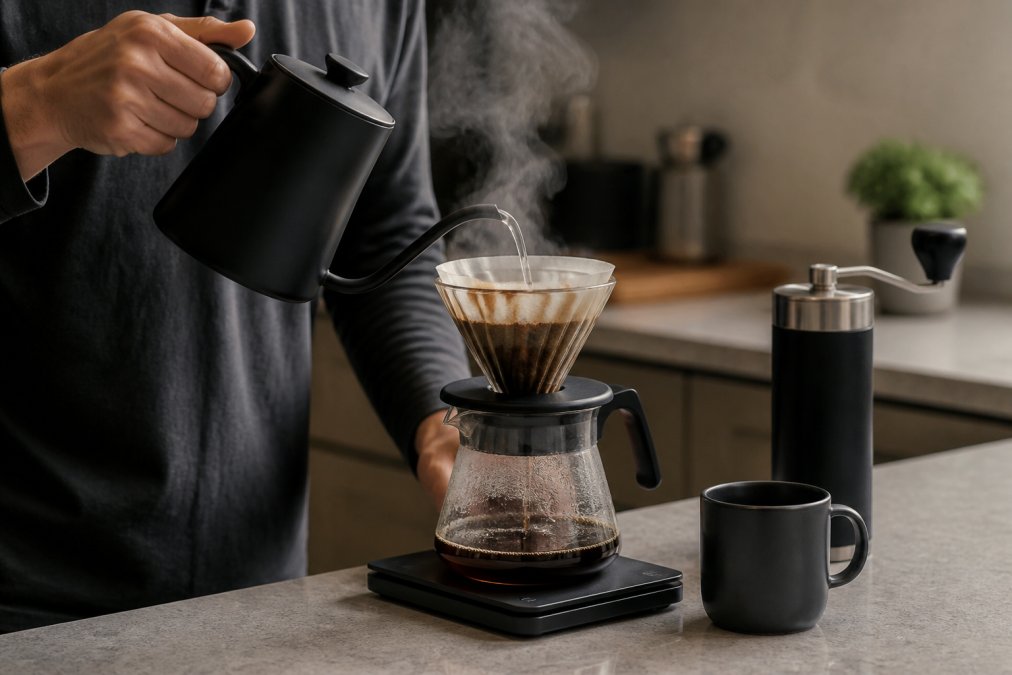
Pour-Over Method
- Rinse the filter with hot water, then discard the rinse water.
- Add 19 grams of medium-fine grounds and level the bed.
- Pour 40 grams of water to saturate the grounds and let it bloom for 30 seconds.
- Pour in slow circles to 300 grams total, keeping the water level steady.
- Let it drain fully. Total brew time should land between 2:30 and 3:30.
French Press Method
- Add 20 grams of medium-coarse grounds to the carafe.
- Pour 300 grams of water at 93°C and stir once.
- Fit the lid and steep for 4 minutes.
- Press the plunger slowly and pour immediately to stop extraction.
For a convenient option on busy mornings, Gilded Grind's Pour Over Coffee Box uses single-use pour over bags that remove the measuring step entirely.

How to Store Premium Coffee Beans for Lasting Freshness
To store premium coffee beans, keep them in an airtight, opaque container at room temperature, away from light and moisture. Whole beans stay fresh longer than ground, so grind just before brewing.
Skip the fridge and freezer for daily-use beans. Both introduce moisture and odors every time you open the container. Buy in smaller quantities and reorder more often instead. Gilded Grind's Sumatra G1 Organic whole bean offering is a good example of a dark roast that holds its syrupy, dark chocolate character well when stored properly.

Measuring TDS and Extraction Yield: The Barista's Secret
Total dissolved solids (TDS) is the percentage of coffee solids present in your brewed cup, measured with a refractometer. Extraction yield is the percentage of the coffee's mass that ended up in the cup, calculated from TDS and your brew ratio.
The target extraction yield is roughly 18-22% (sca.coffee). Below 18% the cup tastes sour and under-extracted; above 22% it turns bitter and dry. This is the measurement most home brewers skip, and it's the fastest way to diagnose a bad cup without guessing.
Common Mistakes That Ruin Professional Coffee at Home
The biggest mistake is inconsistency: changing several variables at once, then not knowing which one caused the improvement or the failure. Change one thing per brew.
Other frequent errors:
- Using a blade grinder, which produces uneven particles and causes channeling
- Guessing at water temperature instead of measuring it
- Storing beans in the fridge, where moisture degrades them
- Reusing old, stale grounds to "save" coffee
- Pouring too fast, which floods the bed and under-extracts
For a reliable base, Gilded Grind's Huila Colombia Ground Dark is ground before shipping and works across most brewing methods, which removes one variable while you dial in the rest.

Frequently Asked Questions
How do you achieve a consistent grind size for professional brewing?
A burr grinder is essential for consistency. Unlike blade grinders that chop unevenly, burr grinders crush beans to a uniform size. For pour-over, aim for a medium-fine grind similar to table salt. For French press, use a coarse grind like sea salt. Adjust one notch at a time and taste the difference. Consistent particle size prevents channeling, where water finds the path of least resistance and leaves some grounds under-extracted while others turn bitter.
Why is water temperature critical for coffee extraction?
Water temperature controls how quickly flavor compounds dissolve. The ideal range is 90-96°C. Water that is too hot scalds the grounds and pulls out harsh, bitter compounds. Water that is too cool under-extracts, leaving coffee sour and weak. Use a variable-temperature kettle or let boiled water rest for 30-60 seconds before pouring. For darker roasts, aim lower in the range; lighter roasts benefit from the higher end.
What are the essential tools for a professional home coffee setup?
Start with a burr grinder, a digital scale accurate to 0.1 grams, and a gooseneck kettle for controlled pouring. A timer helps track brew time consistently. For brewing, choose a pour-over dripper or French press based on your preferred flavor profile. Fresh beans stored properly matter as much as equipment. You do not need everything at once; build your setup gradually, prioritizing the grinder and scale first.
How does the coffee-to-water ratio affect flavor profile?
The ratio determines strength and balance. A common starting point is 1:15 to 1:17 (one gram of coffee to 15-17 grams of water). Lower ratios like 1:15 produce bolder, more intense cups. Higher ratios like 1:17 yield lighter, more delicate flavors. Adjust based on your beans and taste. A scale makes this repeatable. If coffee tastes weak, reduce water slightly; if too bitter, increase it.
Getting professional coffee at home comes down to control, not expensive gear. The hard part is sourcing beans fresh enough to reward that control, and that's where Gilded Grind helps. Our collection spans light to dark roast profiles, including certified organic options and convenient bundles, so you can match the bean to your method. Get started with Gilded Grind and brew a cup worth savoring.


