
Table of Contents
- What You'll Need to Start Brewing Pour Over Coffee
- The Best Coffee to Water Ratio for Pour Over
- Pour Over Coffee Grind Size Guide
- How to Bloom Coffee Grounds Before You Pour
- How to Make Pour Over Coffee: Step-by-Step Brewing Process
- Water Temperature and Pouring Technique for Better Extraction
- Troubleshooting Common Pour Over Mistakes
- Frequently Asked Questions
Last Updated: September 18, 2026
What You'll Need to Start Brewing Pour Over Coffee
Learning how to make pour over coffee for beginners starts with a short list of gear. You do not need a wall of gadgets. At Gilded Grind, we tell new brewers to buy four things and skip the rest.

Here is your starter kit:
- Pour-over dripper - a cone or flat-bottom dripper
- Paper filters - matched to your dripper shape
- Gooseneck kettle - for slow, steady pouring
- Burr grinder - for even grind size
- Digital scale - measures coffee and water in grams
- Digital timer - tracks brew time
A kitchen scale matters more than a fancy kettle. Coffee is measured by weight, not scoops. One scoop of fine grounds weighs more than one scoop of coarse grounds, so scoops give you a different cup every morning.
Start with a medium-fine grind and adjust from there. Freshly ground beans lose aroma fast, so grind right before you brew.
Cone vs. Flat-Bottom Drippers: Which Should a Beginner Buy?
The two shapes behave differently, and the choice affects how forgiving your brew is.
- Cone drippers (V60-style, 60-degree walls) have a single large hole and deep bed. Water flows fast, so they reward good technique and punish sloppy pours. Great for clarity and brightness, less forgiving for beginners.
- Flat-bottom drippers (Kalita Wave-style) have three small holes and a flatter bed. The restricted flow slows things down and evens out extraction, so a slightly uneven pour still produces a decent cup. This is the friendlier first dripper.
If you are brand new, start with a flat-bottom dripper. Move to a cone once your pour is steady.
Can You Brew Pour Over Without the Full Kit?
Yes. You can get a drinkable cup with improvised gear, though consistency suffers.
- No gooseneck kettle? Use a regular kettle and pour slowly from a mug with a spout, or transfer hot water to a measuring cup with a pouring lip. You lose stream control, so expect more channeling.
- No burr grinder? Ask a shop to grind for you, but buy only what you will use in a few days. Pre-ground coffee stales quickly and the grind is locked in, you cannot adjust it later.
- No scale? A tablespoon of medium-fine coffee is roughly 5 to 6 grams, so 3 to 4 tablespoons lands near a 20-gram dose. Treat this as a starting point, not a rule, and taste-test.
- No timer? Use your phone. Brew time is one of your main feedback signals, so do not skip tracking it.
The trade-off is real: improvised gear works, but you will chase consistency. Buy the scale and burr grinder first if you are building the kit over time.
The Best Coffee to Water Ratio for Pour Over
The best coffee to water ratio for pour over is 1:15 to 1:17 by weight. That means 1 gram of coffee for every 15 to 17 grams of water.

For one mug, use 20 grams of coffee and 300 grams of water. That lands near 1:15 and fills a standard 10-ounce cup.
Why weight and not volume? A gram is a gram every time. A tablespoon is not.
| Cups | Coffee (g) | Water (g) | Ratio |
|---|---|---|---|
| 1 | 20 | 300 | 1:15 |
| 2 | 30 | 480 | 1:16 |
| 4 | 60 | 960 | 1:16 |
Too strong? Add water. Too weak? Use more coffee, not less water. Watery coffee usually means too little grounds, not too much liquid.
Pour Over Coffee Grind Size Guide
Pour over coffee grind size should look like table salt: medium-fine, with grains that feel like sand between your fingers. This is the single biggest lever on flavor.
Grind too fine and water stalls, the brew turns bitter, and draw-down time drags past four minutes. Grind too coarse and water rushes through, leaving a sour, thin cup.
Use a burr grinder, not a blade grinder. Blade grinders chop unevenly, so you get dust and boulders in the same batch. That uneven bed causes channeling, where water finds one path and skips the rest of the coffee.
Quick reference:
- Too fast (under 2:30): grind finer
- Too slow (over 4:00): grind coarser
- Just right: 2:30 to 3:30 total brew time
Adjust one notch at a time. Small changes move flavor more than you expect.
How to Bloom Coffee Grounds Before You Pour
To bloom coffee grounds, pour about twice the weight of your coffee in hot water, then wait 30 to 45 seconds. For 20 grams of coffee, that is roughly 40 grams of water.
The bloom is fresh coffee releasing carbon dioxide.
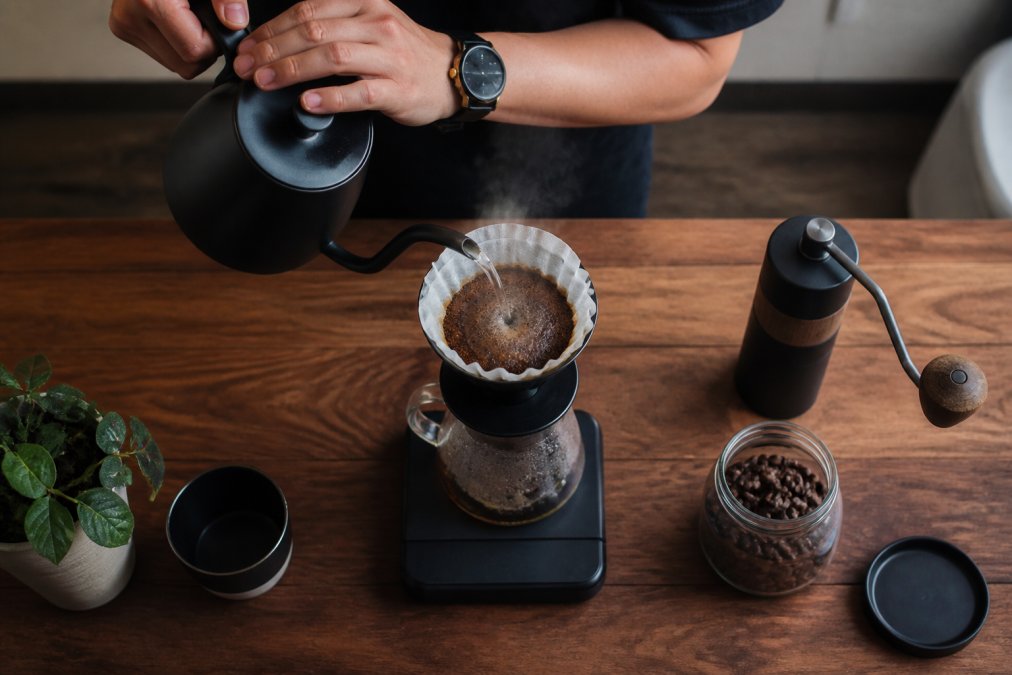
How to Make Pour Over Coffee: Step-by-Step Brewing Process
Here is the full pour over process, start to finish. Total time is about 4 minutes.
- Heat your water to just off boiling. [Time: 3 minutes]
- Rinse the filter with hot water, then dump the rinse water. [Time: 30 seconds]
- Add 20 g of medium-fine coffee and level the bed. [Time: 20 seconds]
- Start the timer and bloom with 40 g of water. Wait 30 to 45 seconds.
- Pour in slow circles up to 150 g, keeping the water level steady. [Time: 45 seconds]
- Finish the pour to 300 g total, then let it draw down. [Time: 1 minute]
- Swirl the dripper gently to flatten the bed and help the last drops through.
Water Temperature and Pouring Technique for Better Extraction
Water temperature for pour over should sit between 90°C and 96°C. Boiling water scorches delicate light roasts and pulls out bitterness. Water that is too cool under-extracts and tastes sour.
How to Read Your Cup: Visual and Taste Cues for Extraction
Beginners struggle because "under-extracted" and "over-extracted" are abstract. Here is how to translate what you see and taste into a fix.
Taste cues:
- Sour, sharp, salty, thin, under-extracted. The water did not pull enough out of the grounds. Fix: grind finer, raise temperature slightly, or slow your pour.
- Bitter, dry, harsh, hollow, over-extracted. Too much was pulled out. Fix: grind coarser, lower temperature slightly, or speed up the pour.
- Balanced, sweet, clear, in range. Note the grind setting and repeat it.
Visual cues during and after the brew:
- Fast draw-down, watery bed, grind too coarse or pour too fast.
- Stalled flow, muddy bed, grind too fine or too many fines clogging the filter.
- Cratered or uneven bed, channeling from a fast or off-center pour.
- Pale, dry patches, water never reached those grounds; swirl during the bloom.
- Flat, even bed, good sign. Extraction was even.
Troubleshooting Common Pour Over Mistakes
| Problem | Likely Cause | Fix |
|---|---|---|
| Bitter, harsh taste | Grind too fine, water too hot | Grind coarser, cool water slightly |
| Sour, thin taste | Grind too coarse, water too cool | Grind finer, raise temperature |
| Brew stalls, no flow | Too many fines, filter clogged | Coarser grind, fresh filter |
| Weak, watery cup | Too little coffee | Increase dose, check ratio |
| Uneven extraction | Channeling from fast pour | Slow down, pour in circles |
- Weigh your beans every time. Eyeballing leads to drift.
- Grind fresh. Aroma fades within minutes of grinding.
- Keep beans sealed and away from light. Oxygen and heat stale coffee fast.
- Clean your gear. Old oils turn rancid and taint every brew.
For home composting of spent grounds, Environment and Climate Change Canada's waste reduction guidance outlines how organic waste breaks down and why keeping it out of landfill helps.
Frequently Asked Questions
What is the easiest pour over coffee method for beginners?
Start with a simple recipe: 15 grams of medium-fine coffee to 250 grams of water at 93°C. Rinse your paper filter, add coffee, pour 30 grams of water to bloom for 30 seconds, then pour the rest in slow circles over 2 to 3 minutes. This pour over coffee method keeps variables minimal so you can focus on consistency rather than perfection.
How much coffee do you use for a pour over coffee?
A reliable starting point is a 1:15 to 1:17 coffee-to-water ratio by weight. For one mug, that means roughly 15 grams of coffee to 250 grams of water. Use a digital scale rather than scoops, since volume varies with grind size and bean density. Adjust slightly stronger or weaker once you know your preferred taste.
Can you use regular ground coffee to make pour over coffee?
You can, but results vary. Standard pre-ground coffee is often too fine for pour over, which slows draw-down and can taste bitter or muddy. A medium-fine grind from a burr grinder gives you more control. If you only have pre-ground, look for a medium grind labeled for drip or filter brewing and adjust your pour speed to compensate.
Why is the bloom phase important in pour over brewing?
When hot water first hits coffee grounds, carbon dioxide trapped inside escapes as bubbles, a process called degassing. The bloom lets that gas release before the main pour so water can extract flavor evenly. Skip it and the CO2 pushes water away from the grounds, causing uneven extraction, channeling, and a flatter cup.
A great pour over comes down to control: the right ratio, the right grind, and a steady hand. Gilded Grind makes that easier with premium beans built for the ritual, from light, bright roasts to deep, rich profiles. Our convenient bundles bring freshly brewed quality to your counter, and our range of roast intensities lets you dial in the cup you actually want. Get started with Gilded Grind and turn your morning brew into a moment worth savoring.


