
Table of Contents
- What Is a Coffee Roasting Profile?
- How Temperature and Time Shape Your Roast
- The Four Stages of the Roasting Process
- Coffee Roast Levels Chart: Light, Medium, and Dark
- Impact of Roast Profile on Flavor Notes
- Best Brewing Methods for Different Roast Profiles
- Troubleshooting Common Roasting Profile Failures
- Conclusion
Last Updated: August 30, 2026
What Is a Coffee Roasting Profile?
A coffee roasting profile is the precise sequence of temperature changes and timing applied to green coffee beans during roasting to develop flavor, aroma, and color. It's the blueprint that transforms raw, grassy beans into the aromatic, complex product you brew at home.
Think of it as a recipe. Just as baking requires specific temperatures and timing, coffee roasting requires deliberate heat management to unlock each bean's unique character. Every roaster, whether commercial or home-based, follows some version of a roasting profile.
The profile captures three critical variables: bean temperature, the rate at which that temperature rises (Rate of Rise or RoR), and total development time. Small changes in any of these create measurably different results in the cup. A profile reaching first crack at 195°C in 8 minutes will taste different from one reaching it at 200°C in 10 minutes, even if both are technically "light roasts."
Understanding roasting profiles means grasping how heat moves through beans, when chemical reactions happen, and how those reactions shape flavor. It's chemistry and control.
How Temperature and Time Shape Your Roast
Temperature and time work together as the two levers controlling roast development. A roast spending 12 minutes at moderate heat tastes different from one spending 10 minutes at higher heat, even if both reach the same final bean temperature.
The endothermic phase happens first. When green beans enter heat, they absorb energy without their temperature rising immediately. This drying phase typically lasts 3-5 minutes. Beans lose moisture, color shifts from green to yellow, and they smell grassy or toasted. Heat transfer occurs primarily through conduction and convection.
Once moisture drops sufficiently, the beans' temperature rises more rapidly. This marks the exothermic phase, where beans generate heat through chemical reactions. The Maillard reaction begins in earnest. Sugars break down, amino acids recombine, and hundreds of flavor compounds form.
The Rate of Rise during this exothermic phase is critical. A fast RoR of 15°C per minute produces a different cup profile than a slow RoR of 8°C per minute. Faster rises preserve origin flavors and acidity; slower rises allow deeper caramelization and darker body development.
Time also determines how long chemical reactions continue. The longer beans stay in the roaster after first crack, the more caramelization occurs and the darker the roast becomes. Push too far and you lose origin character, replacing it with generic roasted bitterness.
The Four Stages of the Roasting Process
Every roast passes through four distinct stages. Understanding these helps you recognize what's happening inside the drum and why the profile matters.
Stage 1: Drying (0-4 minutes) Beans absorb heat and lose moisture. Color shifts from green to pale yellow. Aroma smells grassy or vegetal. Thermal mass is highest here, making heat transfer slow. This stage sets the foundation. Rush it and you'll underdevelop the roast; extend it too long and you'll dry the beans unevenly.
Stage 2: First Crack (4-8 minutes) As moisture content drops, bean temperature rises rapidly. Around 195-205°C, pressure inside each bean builds until it cracks audibly (peer-reviewed research). This marks the transition from drying to active flavor development. The bean surface becomes uneven and slightly wrinkled. Many light roasts end just after first crack, while medium roasts continue past it.
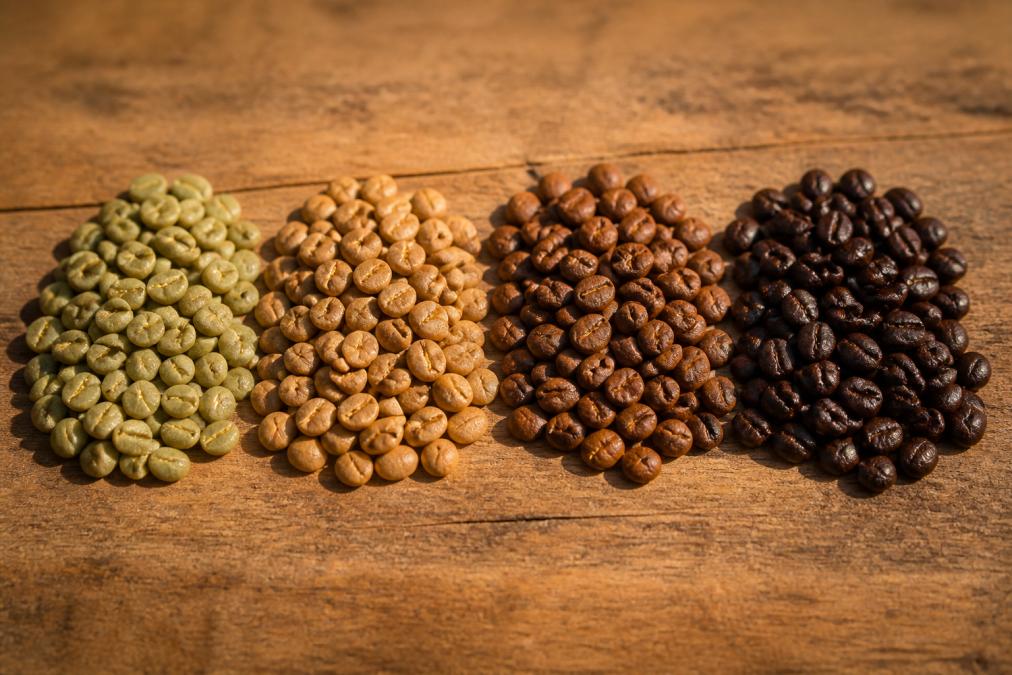
Stage 3: Development (8-12 minutes) After first crack, the exothermic reaction accelerates. Beans continue darkening as caramelization deepens. Sugars break down into simpler compounds, creating sweetness and body. Acids diminish. The Rate of Rise typically slows because beans generate their own heat. A short development time (30-60 seconds past first crack) produces a light roast with bright acidity and origin character. A longer development (2-4 minutes past first crack) produces a medium roast with balanced sweetness and body. Extended development past second crack produces a dark roast with low acidity and heavy body.
Stage 4: Cooling Once you stop the heat, beans must cool quickly to halt chemical reactions. Many roasters use air cooling or a cooling tray. Without rapid cooling, beans continue darkening from residual heat, making your profile unrepeatable.
Coffee Roast Levels Chart: Light, Medium, and Dark
The three primary roast levels represent different stopping points within the roasting process. They're defined by both visual color and flavor characteristics. Professional roasters use the Agtron scale or cupping to verify roast degree.
Light Roast Light roasts end shortly after first crack, typically at 200-205°C. Visually, they're light brown like cinnamon or milk chocolate. The surface remains relatively smooth because development time is minimal.

In the cup, light roasts emphasize origin character and terroir. Acidity is bright and crisp. Body is light. Common flavor notes include floral, fruity, and tea-like qualities. Light roasts are ideal for filter brewing methods where clarity matters.
Medium Roast Medium roasts continue past first crack, typically stopping between 210-220°C. Visually, they're medium brown like caramel. The surface shows visible cracks and uneven texture.
Medium roasts balance origin character with roast-developed flavors. Acidity is moderate. Body is fuller than light roasts. Sweetness from caramelization becomes apparent. Common notes include chocolate, nuts, and dried fruit. Medium roasts work well across brewing methods, making them versatile and widely appealing.
Dark Roast Dark roasts extend well past first crack, often approaching or passing second crack (around 225°C). Visually, they're dark brown to nearly black with heavily cracked surfaces and an oily sheen.
Dark roasts prioritize roast character over origin. Acidity is low. Body is heavy and full. You taste chocolate, caramel, smoke, and spice, flavors created by the roasting process itself. Origin character is largely obscured. Dark roasts are traditional in espresso and French press brewing, where body and boldness are valued.
Impact of Roast Profile on Flavor Notes
The roasting profile directly determines which flavor compounds develop and which diminish. Two beans from the same origin, roasted to different profiles, taste noticeably different.
Light roasts preserve volatile aromatics, the delicate compounds that give origin character. They also retain more of the bean's natural acids, contributing brightness and complexity. The Maillard reaction is just beginning, so roast-derived flavors are subtle. You taste the bean's terroir most clearly.

Medium roasts develop caramelization more fully. Sugars break down into sweet and slightly bitter compounds. Acids are reduced but still present, providing balance. The Maillard reaction creates chocolate and nut flavors. Origin character remains recognizable but is complemented by roast-developed flavors.
Dark roasts push caramelization to its limit. Sugars fully break down, creating deep caramel and bitter notes. Acids nearly disappear. The Maillard reaction is complete, generating strong chocolate, smoke, and spice flavors. Origin character is nearly lost.
The Rate of Rise also shapes flavor. A faster RoR preserves more acidity and origin character because beans spend less total time at high temperatures. A slower RoR allows more time for caramelization and deeper body development.
Best Brewing Methods for Different Roast Profiles
Roast profile and brewing method are partners. The best brewing method highlights a roast's strengths.
Light roasts shine in filter brewing: pour-over, Aeropress, Chemex, and drip machines with paper filters. These methods produce clean extraction, removing oils that might muddy delicate flavors. Bright acidity and floral or fruity notes come through clearly. Brew time should be 3-4 minutes to avoid over-extraction.
Medium roasts are the most versatile. They work in filter methods, immersion methods (French press, cold brew), and espresso. In filter brewing, they produce balanced cups with good body and clarity. In French press, the fuller body and moderate acidity create a smooth drink. In espresso, they produce balanced shots with sweetness and complexity.
Dark roasts are traditional in espresso machines and French press. Espresso's pressure and high temperature extract the bold, heavy flavors dark roasts offer. French press immersion allows full body and oils to shine. Dark roasts excel in milk-based drinks, where the coffee's strength cuts through milk.
Cold brew works with any roast level, but medium and dark roasts are most common. Dark roasts in cold brew become smooth and chocolate-forward, losing the burnt notes that hot brewing sometimes emphasizes.
Troubleshooting Common Roasting Profile Failures
Even with solid understanding, things go wrong. Here are the most common failures and what they signal.
Baked Coffee The roast tastes flat, dull, and lacking acidity. This happens when the Rate of Rise is too slow throughout the roast. The fix: increase heat input earlier to accelerate the RoR through the drying phase and into first crack.
Underdeveloped Roast Coffee tastes grassy, sour, and thin. The roast ended too early, before the Maillard reaction fully developed. The fix: extend the roast past first crack by 60-90 seconds to allow caramelization and roast-developed flavors to form.
Uneven Roasting Some beans are light while others are dark in the same batch. This signals inconsistent heat distribution or airflow. The fix: check your roaster's airflow settings and drum speed. Ensure green beans are evenly distributed at the start.
Scorched Beans Beans show dark spots or burnt surfaces while interiors are underdeveloped. Heat input is too aggressive early in the roast. The fix: reduce initial heat input and allow a longer drying phase at moderate temperature. Increase airflow to distribute heat evenly.
Inconsistent Profiles You can't reproduce the same roast twice. This is the most common failure for home roasters without data logging. The fix: start recording times and temperatures. Note when first crack occurs, when you stop the roast, and what the final bean color looks like. Even simple notes create consistency.
Conclusion
Understanding coffee roasting profiles boils down to grasping three fundamentals: temperature control, timing, and the chemical reactions that happen between them. A roasting profile is your map through those reactions, guiding you toward the flavors you want to develop.
At Gilded Grind, we offer a curated selection of premium, nature-inspired coffee beans. Our Light Roast Coffee Bundle preserves the bright, delicate flavors of Ethiopian Yirgacheffe and Costa Rican beans. Our Dark Roast Coffee Bundle develops deep chocolate and caramel notes in Sumatra and Colombian origins. And our Medium Roast Bundle balances origin character with roast-developed complexity across six distinct regions.


Whether you're brewing at home or exploring different profiles, the roasting process matters. A well-executed profile transforms green beans into something extraordinary, something worth savoring. Start with one of our curated bundles, taste the difference a thoughtful roast profile makes, and discover your preferred roast level.
Coffee Roasting Standards and Best Practices
Frequently Asked Questions
Q: What is the first crack in coffee roasting?
A: The first crack is a crucial moment in coffee roasting profiles when beans reach approximately 196°C internally. At this point, moisture inside the beans turns to steam, causing them to expand and split with an audible crackling sound. This marks the transition from the drying phase to the development phase, where chemical changes like the Maillard reaction intensify, creating the flavors you taste in your cup.
Q: How does roast profile affect the acidity and body of coffee?
A: Light roasts preserve more acidity and have a lighter body because the beans spend less time in heat, retaining more chlorogenic acid. As you move to medium and dark roasts, the extended heat breaks down these acids through caramelization, resulting in lower acidity and fuller body. Dark roasts develop deeper, bolder flavors with heavier mouthfeel. The roast profile essentially controls how much of the bean's original character remains versus how much is transformed by heat.
Q: Why do roasters track time and temperature during the roasting process?
A: Time and temperature data create a roast curve that determines the final flavor outcome. By logging bean temperature, environmental temperature, and rate of rise (RoR), roasters can reproduce consistent results and adjust for variables like batch size and thermal mass. This data-driven approach prevents underdeveloped coffee or baked flavors, ensuring each roasting profile delivers the intended taste profile every time.
Q: Can I identify the roast profile of my coffee beans just by looking at them?
A: Yes, bean color is a reliable visual indicator. Light roasts appear tan to light brown, medium roasts are medium brown, and dark roasts are dark brown to nearly black. However, the Agtron scale (a standardized color measurement) provides more precision for professionals. For home brewing, examining the bean's surface sheen and overall color gives you enough information to match your beans to the right brewing method and understand what flavor profile to expect.
This article was written using GrandRanker


