
Table of Contents
- Why Coffee Storage Tips for Small Kitchens Matter
- How Long Do Coffee Beans Stay Fresh? Timelines and Trade-Offs
- The Best Coffee Storage Containers for Tight Spaces
- Coffee Storage Away From Heat and Light: Placement Rules
- Small Kitchen Coffee Station Ideas That Save Counter Space
- Storing Whole Beans, Ground Coffee, and Pods Separately
- Planning Storage for Different Kitchen Layouts
- Cleaning and Maintaining Your Coffee Storage Setup
- Frequently Asked Questions
Last Updated: October 21, 2026
Why Coffee Storage Tips for Small Kitchens Matter
Good coffee storage is the practice of protecting beans, grounds, and pods from the four things that flatten flavor: air, light, heat, and moisture.
This guide from Gilded Grind covers how to keep coffee fresh when you have almost no space to work with.
Here's what most storage guides get wrong. They treat coffee like flour, sealed in whatever jar looks nice. Coffee is different.
How Long Do Coffee Beans Stay Fresh? Timelines and Trade-Offs
Whole beans hold their peak flavor for about two to four weeks, then fade slowly over the following months. Ground coffee moves much faster.

Pods sit somewhere in between. Sealed pods keep well for months because the packaging blocks air, but once you open a pod, brew it soon.
The trade-off is simple. Buy smaller amounts more often, or buy in bulk and accept that the last bag won't taste like the first.
| Format | Peak freshness | Best storage | Small-kitchen note |
|---|---|---|---|
| Whole beans | 2-4 weeks | Airtight canister, cool and dark | Buy 300 g-1 kg bags |
| Ground coffee | Days to 1 week | Small airtight tin | Grind to order if you can |
| Sealed pods | Several months | Original box, dark shelf | Keep box off the stove side |
| Opened pod | Same day | Brew it | Don't stockpile loose pods |
The Best Coffee Storage Containers for Tight Spaces
The best coffee storage containers for small kitchens are airtight, opaque, and sized to fit a specific shelf or drawer. Three features decide everything: a real seal, a solid lid, and walls that block light. What most guides skip is the math, how much coffee a given canister actually holds, and how much air you leave inside when you fill it.
Airtight Canisters vs. Original Packaging
Original bags with a one-way valve are not useless. They let gas out and keep oxygen from rushing in. But a folded-over bag on a crowded shelf leaks air every time you open it, and it takes up awkward space.
Airtight canisters win for daily use. Look for a silicone gasket and a clamp or screw lid. Glass looks lovely but lets light through, so keep it in a cupboard or pick a tinted or ceramic version.
- Ceramic canisters: block light fully, stay cool, heavier to move
- Stainless steel: tough, light-proof, can dent
- Tinted glass: good seal, looks good, still shows level
Capacity Math: Match the Container to the Bag
Whole beans are bulky. A rough working rule is that 1 litre of canister holds about 400-450 g of whole beans, depending on bean size and how full you fill it. Ground coffee packs tighter, so 1 litre holds closer to 500-550 g.
| Bag size | Whole-bean canister | Ground canister | Small-kitchen note |
|---|---|---|---|
| 300 g | 700 ml-1 L | 500-700 ml | Fits a 20 cm-deep shelf |
| 500 g | 1.2-1.5 L | 1 L | Check shelf height first |
| 1 kg | 2-2.5 L, or split into two 1-1.25 L tins | 2 L | Splitting beats one oversized tin |
Buying oversized means more air inside, which speeds up staling. A full small tin beats a half-empty large one every time.
Sizing to Your Shelf and Buying Habit
Measure your shelf depth before you buy anything. A canister that is too deep won't fit, and one that is too tall will block the shelf above.
Match the size to how much you buy. If you order a 1 kg bag like our Coffee Whole Beans | 1 kg, split it into two smaller canisters. One lives on the counter for daily use.
Format-Specific Containers
- Whole beans: a 1-1.25 L airtight canister with a little headroom; beans need space to settle
- Ground coffee: a small tin filled close to the top, since grounds stale fastest
- Pods: the original box, kept dark and dry; a drawer insert keeps loose pods from rolling
If you order ground coffee like our Huila Colombia | Ground Dark, decant it into a small tin the day it arrives. A full small tin beats a half-empty large one every time.

Coffee Storage Away From Heat and Light: Placement Rules
Keep coffee storage away from heat and light by choosing a cool, dark cupboard away from the oven, kettle, and sunny windows. Heat speeds up the reactions that flatten flavor.
Good spots:
- A lower cupboard away from the stove
- A drawer that stays closed and cool
- A shelf out of direct sun
Bad spots:
- Above the oven or fridge, where warm air rises
- The windowsill
- Beside the kettle, where steam drifts
Don't store beans in the fridge. Every open and close brings in moisture and food odors, and coffee absorbs both. The freezer works only for long-term storage in a truly sealed bag, and refreezing is a bad idea.
Small Kitchen Coffee Station Ideas That Save Counter Space
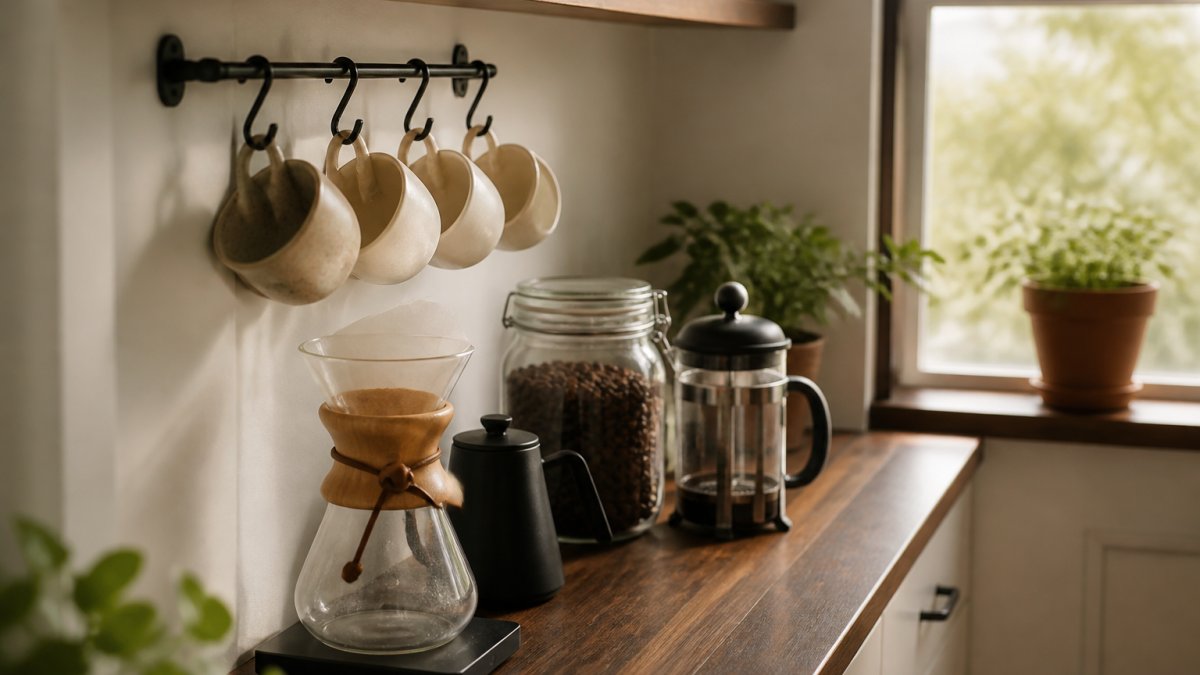
A small kitchen coffee station works when it claims vertical space instead of counter space. Build up, not out.
Vertical and Wall-Mounted Setups
Use the wall above the counter. A slim shelf holds canisters. Hooks underneath hold mugs. A magnetic rack on the side of the fridge holds small tools.
- A floating shelf 20-25 cm deep fits most canisters
- Under-shelf hooks hold mugs and free the counter
- A magnetic strip keeps scoops and small tools off the surface
Renter-Friendly and No-Drill Options
No drills, no damage. These work in any rental.
- Over-the-cabinet-door hooks for mugs and small tools
- Adhesive shelves rated for light loads like pods and filters
- Freestanding tiered racks that sit on the counter and stack upward
Storing Whole Beans, Ground Coffee, and Pods Separately
Store each format on its own terms. Whole beans want an airtight canister with a little room to breathe.
Mixing them in one big jar is a mistake. Grounds dust the beans, pods pick up odors, and you lose track of what's fresh.
A simple three-zone plan:
- Daily canister: whole beans, on the counter, sealed
- Backup tin: ground coffee, small and full, in a cupboard
- Pod box: original packaging, dark shelf, away from heat
If you order ground coffee like our Huila Colombia | Ground Dark, decant it into a small tin the day it arrives.
Planning Storage for Different Kitchen Layouts
Match the plan to the room you actually have. The right setup for a galley kitchen fails in an open-plan one, and a studio kitchen needs a different footprint than a rental with a single counter run. Below are four common layouts with measured starting points. Treat the numbers as a shopping list, not a rulebook, measure your own shelves before you buy.
Galley Kitchen
Two parallel counters with a walkway between them. The constraint is depth, not width, so go vertical on the wall that gets less traffic.
- A floating shelf 20-25 cm deep above the counter holds two to three 1-litre canisters
- Under-shelf hooks hold four to six mugs and free the counter
- A rolling cart 30-40 cm wide at the end of the run tucks away when you cook
A common pattern is to dedicate one wall to brewing and the other to cooking, so steam and heat stay away from the beans.
Open-Plan Kitchen
The kitchen is visible from the living space, so clutter matters as much as capacity. Hide the bulk and display only what looks intentional.
- Closed cupboard for backup canisters and pod boxes
- One open shelf for the daily canister and two mugs, nothing more
- A drawer insert for pods and filters keeps small items out of sight
Studio or Tiny Apartment Kitchen
Counter space is measured in centimeters, so almost everything should live in a drawer or on a wall.
- A single wall shelf 60-80 cm long holds beans, filters, and a small grinder
- One drawer for pods, scoops, and spare gaskets
- A narrow trolley 25-30 cm wide fits beside the fridge and rolls out to brew
Shared or Rental Kitchen
You may not control the layout, and you may not be able to drill. Plan for portability and labeling.
- Label your canisters and keep them on your own shelf or in your own bin
- Over-the-cabinet-door hooks for mugs need no tools
- A freestanding tiered rack sits on the counter and moves with you
Measure Before You Buy
Note four numbers for every candidate spot: shelf height, shelf depth, door swing, and the distance to the nearest heat source. Then buy containers that fit those numbers, not the other way around. A canister that is 2 cm too tall will sit on the counter forever.
Cleaning and Maintaining Your Coffee Storage Setup
Clean canisters every few weeks. Old oils go rancid and taint fresh beans.
- Wash glass and ceramic with warm soapy water, then dry fully
- Wipe steel with a damp cloth and dry right away
- Replace worn silicone gaskets, since a tired seal lets air in
Check seals monthly by filling the canister with water and turning it upside down. If it leaks, the seal is done.
A little care keeps your setup working for years. And it keeps every bag of beans, from a bright Light Roast Coffee Bundle | 4 bags to a deep, earthy Sumatra G1 USDA | Dark, tasting the way it should.

Frequently Asked Questions
How should you store coffee beans to keep them fresh?
Keep whole beans in an airtight container in a cool, dark cupboard, away from the stove, oven, and sunny windowsills. Buy in amounts you will finish within a few weeks, and keep the container sealed between uses. For a small kitchen, a compact canister that fits a shelf or a wall-mounted rack works better than a large bin that eats counter space. If you buy a 1 kg bag of Gilded Grind whole beans, split it into a smaller daily-use container and keep the rest sealed.
What is the best container for storing coffee beans?
An airtight container with a tight-sealing lid and an opaque body is the practical choice. It blocks the air, light, and moisture that flatten flavor. Clear glass looks good on an open shelf but lets light in, so store it inside a cabinet or choose a tinted or ceramic option. Size matters as much as material: a container that matches how much coffee you use in two to three weeks keeps the contents fresher than a large one you refill less often.
Where should you store coffee in a small kitchen?
Pick a cupboard or shelf away from the stove, oven, dishwasher, and kettle, since heat and steam speed up staling. A closed upper cabinet near your brewing spot is ideal because it is dark, dry, and out of the way. If counter space is tight, mount a small shelf or hook rack above the machine for mugs and tools, and keep the coffee itself inside the cabinet. Avoid the fridge for daily-use coffee.
Is it better to store coffee beans whole or ground?
Whole beans hold their flavor longer because there is less surface area exposed to air. Grind just before brewing when you can. Ground coffee is convenient and works well for drip or travel setups, but plan to finish an opened bag within a couple of weeks and keep it sealed in an airtight container. Gilded Grind's Huila Colombia ground coffee arrives fresh; store it the same way you would whole beans.
Small kitchens punish clutter and reward a plan. The challenge is fitting fresh coffee, mugs, and gear into a space that's already full. Gilded Grind can help you keep the supply side simple with freshly roasted whole beans, a range of roast profiles from light to dark, and convenient bundles that arrive ready to store. Get started with Gilded Grind and build a coffee corner that keeps every cup tasting like the first.


