
Table of Contents
- The Four Enemies of Coffee Freshness
- How Long Does Coffee Stay Fresh?
- Step 1: Start With Whole Bean and Check the Roast Date
- Step 2: Choose the Best Coffee Storage Containers
- Step 3: Store in the Pantry or the Freezer (Not the Fridge)
- Signs of Stale Coffee and How to Troubleshoot
- Storing Coffee for Travel, Camping, and Long-Term Stockpiles
- Common Storage Mistakes to Avoid
- Frequently Asked Questions
Last Updated: September 15, 2026
The Four Enemies of Coffee Freshness
Learning how to keep specialty coffee fresh starts with understanding what you're actually fighting. Four forces degrade beans: oxygen, light, heat, and moisture. Oxygen drives oxidation, the chemical reaction that turns bright, volatile compounds into flat, papery notes. Light breaks down the aromatic oils that carry a coffee's flavor profile. Heat accelerates every degradation process. Moisture introduces rancidity and clumping. The enemies work together, and defeating all four is the whole game.
Oxygen: The Primary Driver of Staling
Oxygen exposure is the single biggest threat to bean integrity. Freshly roasted beans release carbon dioxide in a process called degassing, and that outward pressure is your friend: while CO2 escapes, oxygen struggles to get in. Once degassing slows, oxygen moves into the porous structure of the bean and starts breaking down volatile compounds. The fix is simple in principle: minimize the air the beans touch. Once degassing slows, oxygen moves into the porous structure of the bean and starts breaking down volatile compounds. The fix is simple in principle: minimize the air the beans touch.
Light, Heat, and Moisture
UV light degrades aromatic oils; opaque storage vessels block it. Heat speeds up oxidation, so a spot above the espresso machine is the worst place in the kitchen. Moisture is subtler. Beans absorb humidity from the air, which muddies the flavor profile and interferes with extraction later. A cool, dark, dry location covers all three.
How Long Does Coffee Stay Fresh?
Whole bean coffee stays fresh for roughly two to four weeks after the roast date when stored in an airtight, opaque container at room temperature (Effect of Temperature and Storage on Coffee’s Volatile Compound Profile and Sensory...). Pre-ground coffee loses its volatile compounds far faster, often within days, because grinding exposes vastly more surface area to oxygen. The freshness window is not a fixed number; it depends on the roast date, the storage vessel, and how often you open it.

That's why the roast date matters more than any printed best-before date. A bag stamped with a "best before" month tells you almost nothing about when the beans were actually roasted. The roast date tells you everything.
| Storage Method | Typical Freshness Window | Best For |
|---|---|---|
| Original bag, rolled shut | 1-2 weeks | Immediate daily use |
| Airtight opaque canister | 2-4 weeks | Everyday brewing |
| Freezer, sealed portions | 1-2 months | Stockpiles, travel |
| Pre-ground, any method | A few days | Convenience only |
Step 1: Start With Whole Bean and Check the Roast Date
Buy whole bean and check the roast date before anything else. Whole beans preserve their volatile compounds far longer than pre-ground coffee, because the intact bean shields its interior from oxygen. This is the highest-use step in the entire routine, and it costs nothing.
When you're shopping, look for a printed roast date, not a best-before date. A common mistake is grabbing the bag with the longest shelf life; that's usually the oldest coffee. If a bag has no roast date at all, treat that as a red flag.
Gilded Grind prints roast dates on its whole bean offerings, so you know exactly how much freshness window you're working with. A 1 kg bag of whole beans gives you enough volume to dial in a routine without reordering constantly.

Step 2: Choose the Best Coffee Storage Containers
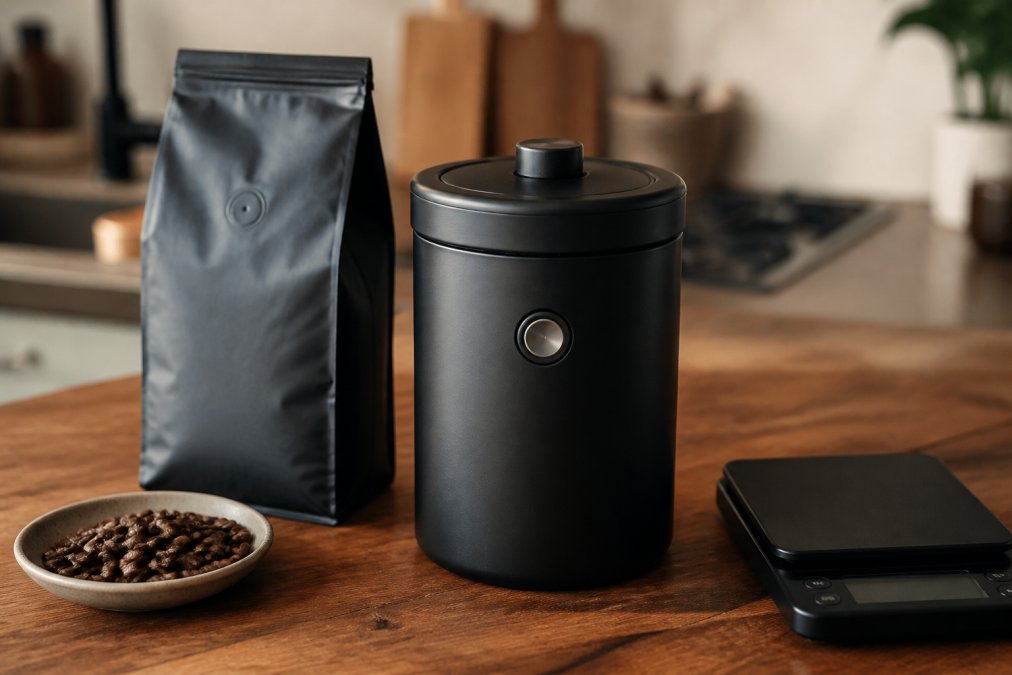
The best coffee storage containers are airtight, opaque, and sized to hold only as much as you'll use in two to four weeks. Airtight blocks oxygen, opaque blocks UV light, and a right-sized vessel means less headspace for stale air to sit in. Glass, ceramic, and matte stainless steel all work; clear jars on a sunny counter do not.
Sizing the Vessel to Your Brewing Volume
Headspace is the quiet variable most guides ignore. Every cubic centimeter of empty air inside a canister is oxygen waiting to react with the beans. A common pattern is a brewer buying a large canister for a 1 kg bag, filling it a third of the way, and wondering why the last third tastes flat. Match the vessel to the volume: a canister that holds roughly one week of beans for your brew rate keeps headspace low and forces you to refill from a sealed reserve rather than opening a big container daily.
As a rough planning figure, a typical drip or pour-over routine uses about 15 to 20 g of beans per cup (Certified - Home Equipment). At two cups a day, that's roughly 210 to 280 g per week, so a canister in the 250 to 350 g range is a sensible daily driver. Larger volumes belong in sealed reserve storage, not the counter canister.
Material Trade-Offs Worth Knowing
- Stainless steel: Blocks light completely, resists odor transfer, and holds up to daily handling. Matte finishes hide fingerprints; polished finishes show them.
- Ceramic: Excellent light blocking and thermal mass, but heavier and prone to chipping if dropped. Choose one with a silicone gasket, not a cork stopper.
- Glass: Inert and easy to clean, but only useful if it's tinted or stored inside a dark cabinet. Clear glass on an open shelf defeats the purpose.
- Silicone-gasketed lids: The gasket is the seal. A clamp lid without a gasket is decorative. Check the gasket periodically; they compress and crack over time.
Why the One-Way Valve Matters
The one-way valve, sometimes called an aroma valve, lets carbon dioxide escape while blocking oxygen from entering. The valve is the reason a good coffee bag can sit on a shelf without going flat.
Vacuum Sealing vs. Nitrogen Flushing
Vacuum sealing removes air from the storage vessel; nitrogen flushing replaces the air with an inert gas before sealing. Vacuum sealing is the practical home option, and it works well for portioning beans you won't touch for a week or more. Nitrogen flushing is a commercial packaging method; you'll see it in professionally sealed bags, not in a home kitchen. For most home setups, a vacuum sealer plus an airtight canister covers both needs.
What to Skip
- Clear jars on open shelves. UV light degrades aromatic oils.
- Hopper storage for anything beyond a day's brew. The hopper is open to air and light.
- Single-compartment canisters for long-term stock. Portion first, then store.
- Containers without a gasket. A lid that rests on the rim is not airtight.
Step 3: Store in the Pantry or the Freezer (Not the Fridge)
Store beans in the pantry for daily use and the freezer for long-term stockpiles. The fridge is the one place to avoid.
Freezer Storage Without Condensation
Signs of Stale Coffee and How to Troubleshoot
Troubleshooting, in order of likelihood:
Storing Coffee for Travel, Camping, and Long-Term Stockpiles
Humidity Hits Roast Levels Differently
Travel and Camping Tactics
Long-Term Stockpiles
Common Storage Mistakes to Avoid
Frequently Asked Questions
How to store specialty coffee for maximum flavor?
Keep whole beans in an opaque, airtight container with a one-way valve, stored in a cool, dark place away from the stove and direct sunlight. Buy only what you will drink within two to four weeks of the roast date, and grind right before brewing. If you buy in bulk, split the bag into smaller portions and freeze what you will not use within a week. This limits oxygen exposure, the main cause of lost aroma and flavor.
Will coffee stay fresh in a Ziploc bag?
A Ziploc bag slows staling but does not stop it. Standard plastic is porous to oxygen over time and offers no barrier against light, so volatile compounds fade faster than in an opaque, airtight container. If a Ziploc is your only option, squeeze out excess air, seal it fully, and keep it in a dark cupboard. Use those beans within a week or two for the best cup.
Does freezing coffee beans actually keep them fresh?
Yes, when done correctly. A freezer slows oxidation and preserves aroma for weeks or months. The key is to freeze beans in small, airtight portions you can use in one go, so you never thaw and refreeze the same bag. Condensation is the risk: let a frozen portion come to room temperature before opening it, and keep it sealed until then. Avoid the fridge, where moisture and food odors cause problems.
What are the signs of stale coffee?
Flat, cardboard-like aroma, muted or bitter flavor, and a lack of the fruity or chocolate notes you expect are the clearest signs of stale coffee. Beans may look dull rather than glossy, and pre-ground coffee loses its scent within days. If a brew tastes hollow no matter how you adjust grind size or ratio, the beans, not your method, are usually the cause. Check the roast date before blaming your equipment.
Keeping specialty coffee fresh is a discipline of small habits: buy whole bean, check the roast date, seal it against oxygen and light, and keep it cool and dry. Gilded Grind makes that easier with freshly roasted, date-stamped whole beans, a range of roast profiles from bright Yirgacheffe Ethiopia to deep Sumatra G1, and convenient bundles that let you portion and freeze without waste. Get started with Gilded Grind and give every cup the freshness window it deserves.


