
Table of Contents
- How Long Does It Take to Learn Coffee Cupping?
- Essential Coffee Cupping Tools for Your First Session
-
Step-by-Step: Your First Cupping Session
- What You'll Need
- Step 1: Set Up and Weigh [Time: 5 minutes]
- Step 2: Pour and Let It Bloom [Time: 4 minutes]
- Step 3: Break the Crust [Time: 1 minute]
- Step 4: Skim and Cool [Time: 3 minutes]
- Step 5: Slurp and Taste [Time: 10 minutes]
- Step 6: Record and Re-Taste [Time: 5 minutes]
- Water Temperature, Brewing Time, and Crust Breaking
- How to Improve Coffee Tasting Skills Through Practice
- Coffee Cupping Sensory Training: Building Your Palate
- Common Beginner Mistakes That Slow Your Progress
- Frequently Asked Questions
Last Updated: October 2, 2026
How Long Does It Take to Learn Coffee Cupping?
Most people can learn coffee cupping basics in a single afternoon. Real sensory skill takes longer. Expect about 3 to 6 months of regular practice to taste with confidence, and 1 to 2 years to score coffee the way a licensed grader does. This guide from Gilded Grind breaks down that timeline, session by session.
Coffee cupping is a standardized method for brewing and tasting coffee to judge its aroma, flavor, acidity, body, and aftertaste.
The good news: you do not need a certificate to start. You need a kettle, a scale, and a willingness to taste badly for a while.
Below, we'll show you exactly how long each stage takes, what to practice, and the mistakes that stall most beginners.
The Learning Curve vs. the Skill Ceiling
The learning curve is short. The skill ceiling is high. That gap is what confuses most beginners.
In your first week, you can learn the whole procedure: weighing grounds, pouring water, breaking the crust, slurping.
What takes time is palate calibration. Your tongue already works. Your vocabulary and memory are what lag behind.
Here is how the timeline usually breaks down:
| Stage | Time to Reach It | What You Can Do |
|---|---|---|
| First session | 1 day | Run the full protocol with a guide |
| Basic competence | 2-4 weeks | Taste acidity, body, and sweetness on purpose |
| Working palate | 3-6 months | Name specific flavors and score consistently |
| Professional level | 1-2 years | Calibrate with a panel and certify |
A common mistake is expecting month-six skills in week one.
Essential Coffee Cupping Tools for Your First Session
You do not need much to start. The essential coffee cupping tools are a digital scale, a kettle, a timer, a spoon, and matched cups. Everything else is a nice-to-have.
The kit that matters most:
- Digital scale with 0.1g accuracy for consistent ratios
- Gooseneck kettle for controlled pouring
- Timer for tracking brewing time
- Cupping bowls or small matched glasses, 150-200ml each
- Cupping spoon or a deep soup spoon
- Notebook for tasting notes
Skip the expensive gear at first. A kitchen scale and four identical mugs will get you through your first month.
If you want to taste a wide spread of flavor profiles without buying six bags, a curated bundle like the Global Coffee Collection | 6 Bags gives you six origins to cup side by side.

Step-by-Step: Your First Cupping Session
A full cupping session takes about 20 to 30 minutes. Here is the standardized protocol, start to finish.
Total Time: 25 minutes Difficulty: Beginner
What You'll Need
- 4 cupping bowls
- 8.25g coffee per bowl, ground medium-coarse
- 150ml water per bowl, just off the boil
- Cupping spoon
- Timer and notebook
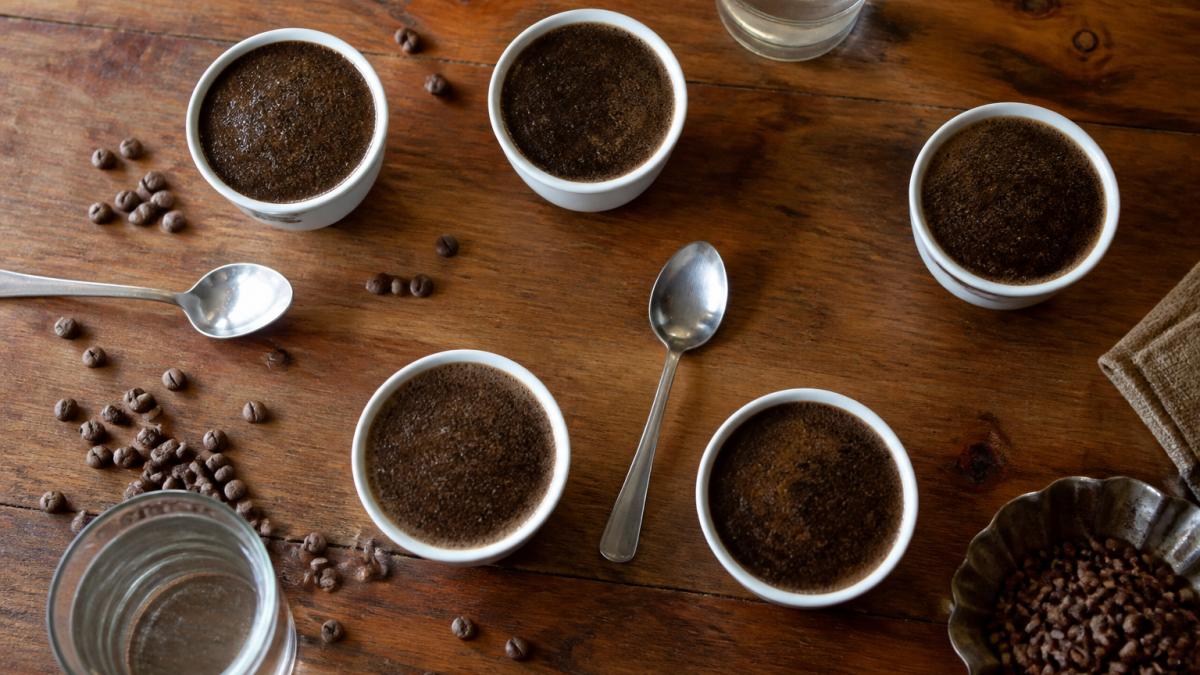
Step 1: Set Up and Weigh [Time: 5 minutes]
Place your bowls in a row. Weigh 8.25g of coffee into each. Grind fresh, medium-coarse.
Expected Result: Four bowls with even, level grounds.
Step 2: Pour and Let It Bloom [Time: 4 minutes]
Pour 150ml of hot water over each bowl. Start your timer. Let the grounds sit undisturbed for 4 minutes.
Step 3: Break the Crust [Time: 1 minute]
At the 4-minute mark, push the floating grounds aside with your spoon. Lean in and smell. This is crust breaking, and it is the most aromatic moment of the session.
Step 4: Skim and Cool [Time: 3 minutes]
Remove the foam and floating grounds. Let the cups cool for a few minutes. Warm coffee hides flaws.
Step 5: Slurp and Taste [Time: 10 minutes]
Take a spoonful and slurp it hard. Slurping spreads coffee across your whole palate and pulls aroma into your nose.
Step 6: Record and Re-Taste [Time: 5 minutes]
Write notes now. Taste again as the coffee cools. Flavors shift.
Global Coffee Collection | 6 Bags →
Water Temperature, Brewing Time, and Crust Breaking
Water temperature should sit between 92°C and 96°C, or about 30 seconds off a rolling boil. Too hot and you taste only bitterness.
Brewing time for cupping is fixed at 4 minutes, not adjusted to taste. That consistency is the whole point of a standardized protocol.
Crust breaking happens at exactly 4 minutes. Push the grounds aside in one clean motion, then smell before you stir.
How to Improve Coffee Tasting Skills Through Practice
Improving coffee tasting skills comes down to repetition with feedback. You cannot read your way to a better palate.
What actually works:
- Cup the same bean twice, blind, and compare notes
- Cup two origins side by side to sharpen contrast
- Keep a running flavor notebook with dates
- Re-taste a coffee you disliked after a month
Blind tasting is the fastest teacher. Cover the labels. If you can name the origin without seeing the bag, your palate is working.
A common mistake is cupping alone forever. Join a local tasting group or trade notes online. Other tasters catch what you miss.
Coffee Cupping Sensory Training: Building Your Palate
Coffee cupping sensory training is the deliberate work of connecting smells and tastes to words.
Start with the basics: acidity, body, sweetness, aftertaste, and uniformity. Score each on a simple 1 to 5 scale. Then build vocabulary.
Olfaction does most of the heavy lifting. What you call "taste" is largely smell. That is why a stuffed nose ruins a cupping session.
A Structured Practice Loop
Random cupping does not build a palate. A loop does:
- Taste blind. Cover the labels. Guess origin, process category, and two descriptors.
- Write before you peek. Commit your notes to paper first. Peeking first contaminates everything.
- Reveal and compare. Note where you were right, wrong, and vague.
- Re-cup the same coffee a month later. Compare your old notes to your new ones. This is where calibration actually happens.
Ten minutes a day beats a three-hour session once a month, because sensory memory is built by repetition, not by volume.
Self-Assessment Metrics That Track Real Progress
Confidence is not evidence. Track four numbers to know if you are actually improving:
- Blind accuracy, how often you identify an origin correctly across ten blind cuppings
- Score consistency, how close your scores land when you cup the same coffee twice, blind
- Note range, how many distinct descriptors you use per coffee, without repeating yourself
- Calibration gap, the difference between your score and a reference score from a more experienced taster
If your blind accuracy rises and your calibration gap shrinks, you are getting better. Both matter more than how confident you feel. A useful benchmark: if your score consistency is within one point on repeat cuppings, your palate is stabilizing.
Why Beginners Plateau
Most plateaus are not sensory limits. They are one of these:
- Palate fatigue. After four or five cups, your sensitivity drops sharply. Cap sessions at four to six coffees and reset with water and a plain cracker.
- Confirmation bias. If you know a coffee is a washed Ethiopian, you will taste jasmine whether it is there or not. Blind tasting is the only cure.
- Descriptor borrowing. Using words you read on the bag instead of words your nose actually found. Write your own notes first, always.
- Inconsistent preparation. If your ratio, grind, or water temperature drifts between sessions, you are comparing your own variables, not the coffee.
Common Beginner Mistakes That Slow Your Progress
The biggest beginner mistakes are procedural, not sensory. Fix the process first and your palate follows.
- Grinding too fine. You get mud, not clarity. Stay medium-coarse.
- Slurping too gently. A timid sip misses most of the aroma.
- Cupping too hot. Wait. Warm coffee hides acidity and sweetness.
- Skipping notes. If you do not write it down, you will not remember it.
- Chasing scores too early. Score after you can describe.
- Cupping one bean at a time. Contrast teaches faster than isolation.
Most of these cost you weeks, not days. Correct them early and your timeline shortens.
If you want a set of contrasting origins to practice against, the Light Roast Coffee Bundle | 4 bags gives you four distinct origins to cup side by side, while the Huila Colombia | Duo lets you compare a medium and dark roast from the same region.


Frequently Asked Questions
How long should coffee steep for cupping?
Coffee should steep for exactly 4 minutes before you break the crust. This timing is part of the standardized protocol used in professional coffee quality assessment. Set a timer, because steeping too long or too short changes the extraction and skews your flavor profile reading. After 4 minutes, stir the crust three times, then let the grounds settle for another 2 to 3 minutes before you begin slurping. Total session time per round runs about 10 to 12 minutes.
What equipment do I need to begin coffee cupping at home?
You need a few essential coffee cupping tools: a digital scale accurate to 0.1 g, a timer, several identical cupping bowls (180 to 200 ml each), a deep-bowled cupping spoon, and a kettle. Filtered water heated to 93 to 96 degrees Celsius completes the setup. A notebook for tasting notes helps you track progress. Start with a Gilded Grind bundle like the Global Coffee Collection to compare six origins side by side in one session.
Is coffee cupping difficult to learn for beginners?
The basic steps take one or two sessions to learn. What takes longer is palate calibration: recognizing acidity, body, sweetness, and aftertaste consistently. Most beginners can run a valid cupping session within a week. Developing the sensory vocabulary and accuracy that professional certification requires takes months of regular practice. The difficulty is not in the procedure but in training your senses to detect and name what you taste.
How does cupping help in identifying coffee quality?
Cupping uses a standardized protocol so every coffee is evaluated under identical conditions: same grind, same water temperature, same brewing time. This lets you compare uniformity, clean cup, sweetness, acidity, body, and aftertaste across samples without brewing variables interfering. A coffee scoring above 80 on the Specialty Coffee Association scale is considered specialty grade. Regular cupping builds the sensory reference points you need to judge coffee quality assessment accurately over time.
Learning to cup takes an afternoon. Learning to taste takes a season. That gap is where most people quit, and it is exactly where Gilded Grind can help. Our curated, nature-inspired beans give you the range you need to train your palate, from bright Yirgacheffe to deep, rich origins, with convenient bundles that keep fresh coffee on your shelf while you practice. Get started with Gilded Grind and turn your daily brew into a skill worth savoring.


