
Table of Contents
- Why Your Pour Over Tastes Off (and How Extraction Explains It)
- Start With the Right Pour-Over Coffee Grind Size
- Dial In Pour-Over Coffee Water Temperature
- Nail the Pour-Over Coffee Ratio for Balance
- Master the Bloom, Pour Pattern, and Agitation
- Use Pour-Over Coffee Drawdown Time as Your Diagnostic
- Troubleshoot by Taste: A Systematic Adjustment Chart
- Frequently Asked Questions
Last Updated: October 17, 2026
Why Your Pour Over Tastes Off (and How Extraction Explains It)
Extraction in pour over coffee is the process of dissolving flavor compounds from coffee grounds into water. Get it wrong, and you taste it immediately: sour and thin, or harsh and bitter.
The fix almost always lives in one of five variables: grind size, water temperature, ratio, pouring technique, or brew time. Below, we'll show you exactly how to adjust each one, and how to read your own cup so you know which lever to pull.
But first, here's what most guides get wrong: they treat these variables as a checklist. They aren't. They interact, and one bad setting can mask another.
Start With the Right Pour-Over Coffee Grind Size
Pour-over coffee grind size is the single biggest lever you control. Medium-fine works for most cone drippers. Too coarse and water races through, leaving sour, underdeveloped flavor. Too fine and the bed clogs, stalling the brew and pulling out bitterness.
How to Read Your Coffee Bed for Grind Clues
After the brew finishes, look at the bed. A level, evenly spent bed with a small dip in the center suggests a healthy brew. Muddy sludge points to too many fines. Loose, sloppy grounds that never fully saturated mean the grind is too coarse or your pour was uneven.
- Sludge and slow drain: grind coarser
- Loose bed, fast drain: grind finer
- Level bed, small center dip: you're close
Dial In Pour-Over Coffee Water Temperature
Pour-over coffee water temperature should sit between 90°C and 96°C for most roasts. Hotter water extracts faster and pulls more bitterness. Cooler water slows extraction and can leave the cup sour.
Light roasts often reward the hotter end. Medium and darker roasts tend to do better a few degrees cooler. If you don't have a temperature-controlled kettle, boil and rest the water for about 30 seconds before pouring.
One warning: don't chase temperature before you've fixed your grind. A perfect 93°C pour over a badly ground bed still tastes wrong.
Nail the Pour-Over Coffee Ratio for Balance
Pour-over coffee ratio is your strength dial, not your extraction dial. That distinction is the whole game. Ratio changes how concentrated the cup tastes; it does not reliably change how much flavor you pull from the grounds. If you confuse the two, you will spend an afternoon chasing the wrong variable.
Start at 1:16, one gram of coffee to sixteen grams of water. For a 250g cup, that is roughly 15.5g of coffee. A common working window is 1:15 to 1:17:
- 1:15, more body, heavier mouthfeel, more forgiving of a slightly coarse grind
- 1:16, the neutral starting point for most cone drippers
- 1:17, lighter, tea-like, and less forgiving of under-extraction
Use a scale. Scoops lie, and consistency is everything here. Weigh the water going in, not just the coffee, so you know exactly what you brewed.
Strength vs. Extraction: The Distinction That Saves Time
Strength is how much dissolved coffee is in the cup, total dissolved solids, or TDS. Extraction is how much of the soluble material you pulled out of the grounds. They are related but not the same, and the taste difference matters:
- Sour and weak, under-extracted and under-strength. Fix extraction first (grind finer, raise temperature), then revisit ratio.
- Sour and strong, under-extracted but concentrated. The ratio is masking an extraction problem; do not open it up further.
- Bitter and weak, over-extracted and thin. Grind coarser or lower temperature, then tighten the ratio slightly.
- Bitter and strong, over-extracted and concentrated. Coarsen the grind and open the ratio toward 1:17.
A common pattern among home brewers is to fix a sour cup by adding more coffee. That makes the cup stronger and still sour. Change extraction variables first; use ratio to fine-tune strength once the flavor is clean.
Testing Ratio Without Confounding Variables
Treat each brew as a controlled test. Hold grind, temperature, pour pattern, and total time steady, and change only the ratio. Brew at 1:16, taste, then brew at 1:15 with everything else identical. Note which cup you preferred and why.
Once you have a ratio that works, lock it and move on to the next variable. A ratio you can repeat is worth more than a ratio that is theoretically perfect.
Master the Bloom, Pour Pattern, and Agitation
The bloom is a short pre-wet that lets trapped gas escape from fresh grounds. Pour roughly twice the coffee's weight in water, wait 30 to 45 seconds, then continue. Skipping the bloom on fresh beans leaves you with an uneven, gassy bed, and an uneven bed is where most pour-over problems start.
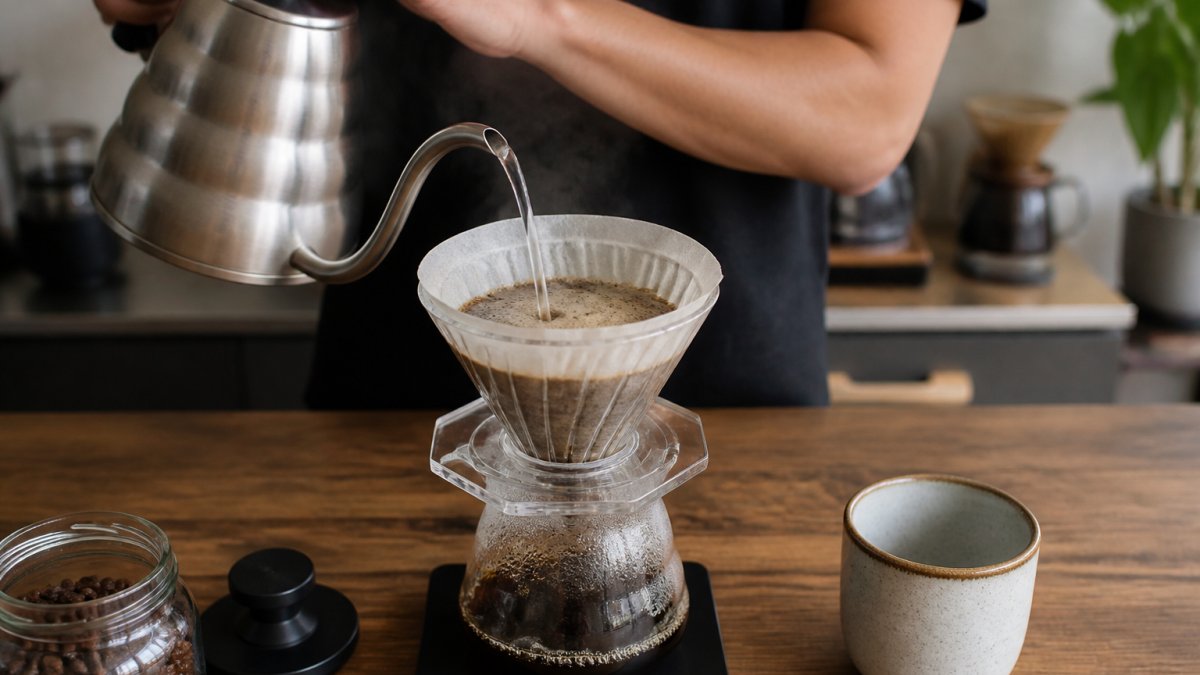
Pouring Technique That Saturates Evenly
A circular pour from the center outward keeps the bed level and the flow even. Keep the spout low and the stream steady. Pouring straight down the middle drills a channel through the grounds, and water takes the path of least resistance every time.
Pour Over Coffee Box | Med-Dark →
Gentle agitation, a small stir or a swirl of the dripper, helps saturate dry pockets. Too much agitation stirs up fines and clogs the filter. The goal is saturation, not turbulence.
Diagnosing Uneven Extraction and Channeling
Channeling is what happens when water finds a fast path through the bed instead of passing evenly through all the grounds. Part of the bed over-extracts while the rest under-extracts, and the cup tastes both harsh and hollow at once. It is the most common cause of a cup that seems to have two personalities.
Watch for these signs:
- A crater or divot in the spent bed, water punched through one spot
- A bed that is level on one side and piled on the other, the pour was off-center
- Fast drawdown with a weak, astringent cup, flow bypassed the grounds
- Muddy patches next to dry patches, poor saturation during the bloom
Common causes and fixes:
| Sign | Likely Cause | Fix |
|---|---|---|
| Crater in spent bed | Concentrated center pour | Pour in wider circles, keep the stream low |
| Lopsided bed | Off-center pouring or a tilted dripper | Level the dripper, pour symmetrically |
| Fast drain, astringent cup | Channeling through fines | Gentle swirl after the bloom, coarser grind |
| Dry pockets after bloom | Too little bloom water | Use 2-3x the coffee weight, swirl gently |
Matching Technique to Your Dripper and Filter
Different setups reward different pouring styles. A cone dripper with a paper filter benefits from a steady spiral and a gentle swirl; a flat-bed dripper rewards a slower, more deliberate pour that keeps the bed level. Thicker paper filters slow the flow and tolerate a finer grind; thinner filters drain faster and punish an uneven pour.
Start with a level bed, a low steady stream, and one gentle swirl after the bloom. Adjust from there, one change at a time, and let the spent bed tell you what the water actually did.
Use Pour-Over Coffee Drawdown Time as Your Diagnostic
Pour-over coffee drawdown time is the clock on your brew. For a single cup, aim for a total brew between 2:30 and 3:30. Drawdown is the final drain through the bed, and it tells you how the whole brew behaved.
A drawdown that drags past a minute usually means the grind is too fine or the bed is clogged with fines. A drain that finishes in seconds points to too coarse a grind or a pour that never saturated the grounds.
| Symptom | Likely Cause | Fix |
|---|---|---|
| Sour, thin cup | Under-extraction | Grind finer, raise temperature |
| Bitter, harsh cup | Over-extraction | Grind coarser, lower temperature |
| Slow drawdown, muddy bed | Too many fines | Coarser grind, less agitation |
| Fast drawdown, weak cup | Coarse grind, uneven pour | Finer grind, slower circular pour |
| Uneven bed, channeling | Poor saturation | Better bloom, gentle swirl |
Troubleshoot by Taste: A Systematic Adjustment Chart
Taste is the final judge, and it beats any timer. Sourness means you're under-extracted. Bitterness means you've gone too far. Astringency, that drying sensation, usually signals channeling or over-extraction in part of the bed.
Work through one change at a time. Adjust grind, brew again, taste. Then move to temperature. Then ratio. Changing two variables at once teaches you nothing.
Controlled Experiments for Dialing In
Treat each brew as a test. Hold four variables steady and change only the fifth. Taste, note the result, then adjust again. This is how you build a recipe that works with your grinder, your dripper, and your water, not someone else's.
Once your technique is dialed in, the beans deserve the same care. Our Yirgacheffe Ethiopia rewards a clean, even extraction with its floral and citrus notes, while the Limu Ethiopia light roast shines when you keep the bed level and the temperature up.


Frequently Asked Questions
How do I know if my pour over coffee is under-extracted or over-extracted?
Taste is the clearest signal. Under-extracted pour over coffee tastes sour, sharp, and thin, with a hollow finish and little sweetness. Over-extracted coffee tastes bitter, drying, and ashy, with a heavy mouthfeel that lingers. Check your drawdown time and coffee bed too: a fast drawdown with a pale, uneven bed points to under-extraction, while a slow drawdown and muddy bed point to over-extraction. Adjust one variable at a time, starting with grind size, and taste again before changing anything else.
What pour-over coffee ratio should I start with?
A reliable starting point is 1:16, meaning 15 grams of ground coffee to 240 grams of water for a single mug. If the cup tastes weak or watery, tighten the ratio toward 1:15. If it tastes heavy or muddy, loosen toward 1:17. Weigh both the coffee and the water on a scale in grams rather than using scoops, because ground coffee volume varies widely with grind size. Keep the ratio fixed while you adjust grind and temperature, then fine-tune the ratio last for strength.
How long should a pour-over brew take?
Most pour-over recipes finish brewing in about 2:30 to 3:30 from the start of the bloom, including drawdown. A brew that finishes well under two minutes usually means the grind is too coarse or the pour was too fast, and the cup will taste sour or thin. A brew that stalls past four minutes usually means the grind is too fine or the filter is clogged with fines, and the cup will taste bitter. Treat drawdown time as a diagnostic, not a target to force.
Does pouring technique really affect pour-over extraction?
Yes. A slow circular pour from a gooseneck kettle keeps the coffee bed level and saturates the grounds evenly, so water passes through all the coffee at a similar rate. Pouring hard into one spot channels water through a single gap, leaving much of the bed under-extracted while the rest turns bitter. Keep the water level steady, pour in gentle spirals, and avoid letting the bed go dry between pours. Agitation helps early in the brew but should ease off as drawdown begins.
Great pour over coffee comes down to control, and control starts with good beans and a repeatable process. If your brews still taste flat, the coffee itself may be the variable you haven't tested. Gilded Grind offers freshly roasted single-origin beans and convenient pour over bundles, with a range of roast profiles to match your taste. Shop the full collection and give your next cup the foundation it deserves.


