
Table of Contents
- Is a Burr Grinder Worth the Upgrade? The Short Answer
- Burr Grinder vs Blade Grinder: The Core Difference
- Why Coffee Grind Consistency Decides Flavor
- Manual vs Electric Burr Grinder: Which Fits Your Routine
- Conical vs Flat Burrs: What the Shape Changes
- The Best Coffee Grinder for Home Brewing by Brew Method
- Upgrade Decision Framework: Budget, Habits, and Total Cost
- Conclusion
- Frequently Asked Questions
Last Updated: October 15, 2026
Is a Burr Grinder Worth the Upgrade? The Short Answer
Yes, for most home brewers, a burr grinder is the single most impactful upgrade you can make to your coffee setup. A burr grinder is a coffee grinder that crushes beans between two rotating abrasive surfaces, producing uniform particles instead of the random chunks and dust a blade grinder creates (Flat vs Conical Burr Grinder: What You Should Know).
Below, we break down exactly what changes, what it costs, and when you should skip the upgrade entirely.
What Changes in the Cup When You Switch
The most noticeable change is clarity. With uniform coffee grounds, water passes through the coffee bed at a consistent rate, pulling flavor evenly rather than stripping some particles and barely touching others. You taste the jasmine in a Yirgacheffe, not a muddy approximation of it. You also gain control: adjusting grind size lets you fine-tune a brew instead of accepting whatever the blade produces that morning.

Burr Grinder vs Blade Grinder: The Core Difference
The core difference is consistency. A blade grinder spins a metal blade like a propeller, chopping coffee beans into a mix of powder and gravel.
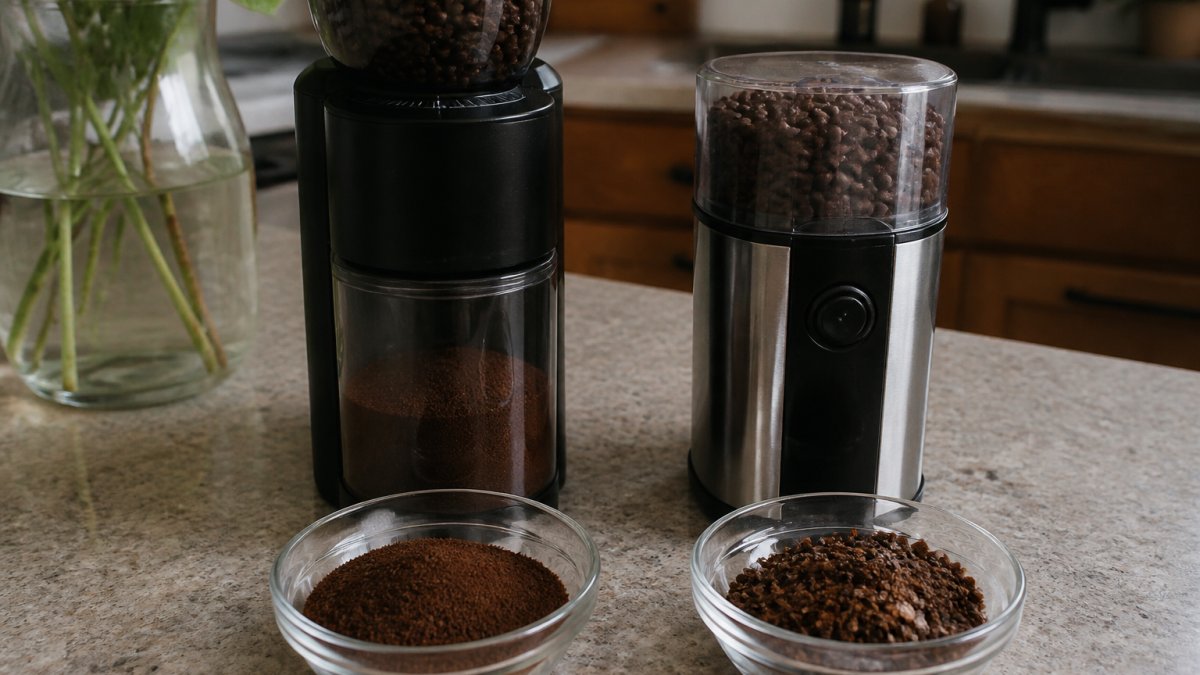
How Each One Breaks Down a Bean
Blade grinders smash and chop. Beans closest to the blade pulverize into dust while outer beans stay coarse, and no amount of extra pulses fixes the spread. Burr grinders shear. Each bean passes through the same gap, so the output is a consistent grind. The practical result: blade grinders produce coffee grounds you cannot reliably repeat, while burr grinders give you a setting you can return to tomorrow.
Price and Longevity Compared
Blade grinders cost less upfront but typically wear out faster and offer no meaningful grind adjustment. Burr grinders cost more initially, yet the burrs themselves are built to last for years of daily brewing, and replacement burrs are usually available separately. When you spread that cost across its working life, the daily difference is small.
| Factor | Blade Grinder | Burr Grinder |
|---|---|---|
| Grind consistency | Uneven mix of dust and chunks | Uniform particle size |
| Grind adjustment | None or minimal | Precise, repeatable settings |
| Best for | Occasional drip coffee | Espresso, pour-over, French press |
| Lifespan | Shorter, blade dulls | Years of daily use |
| Flavor control | Low | High |
Why Coffee Grind Consistency Decides Flavor
Coffee grind consistency decides flavor because extraction depends on surface area. Water dissolves compounds from coffee grounds, and smaller particles give up their flavor faster than larger ones. When every particle is roughly the same size, they extract at the same rate, and the cup tastes balanced. When sizes vary wildly, some grounds over-extract while others under-extract, and both faults land in the same mug.
Over-Extraction, Under-Extraction, and the Middle Ground
Over-extraction happens when fine particles release too many bitter, harsh compounds. Under-extraction happens when coarse particles release too few, leaving the cup sour and thin. A uniform grind keeps you in the middle ground, where sweetness and acidity balance. This is why grind consistency matters more than almost any other variable in coffee brewing.
Manual vs Electric Burr Grinder: Which Fits Your Routine
Manual burr grinders suit small batches, travel, and quiet mornings, while electric burr grinders suit daily volume and speed. A manual grinder gives you full control and takes up almost no counter space, but grinding enough for a full French press by hand takes real effort. An electric grinder trades that effort for convenience, which matters if you brew before you are fully awake.
Noise, Mess, Retention, and Daily Workflow
Electric grinders are louder but faster, and most contain some retention: a small amount of ground coffee left inside from the previous session. Manual grinders are nearly silent and retain almost nothing, but they demand your hands for a minute or two. Neither is objectively better. Match the tool to the ritual you actually keep.
Conical vs Flat Burrs: What the Shape Changes
Conical burrs use a cone-shaped inner burr inside a ring, while flat burrs use two parallel discs. Conical burrs tend to produce a slightly wider particle spread and often run quieter and at lower cost. Flat burrs generally deliver a tighter, more uniform grind, which many espresso brewers prefer. For most home setups, the difference is subtle; grind consistency and adjustment range matter far more than burr shape alone.
The Best Coffee Grinder for Home Brewing by Brew Method
Most guides tell you to "match the grinder to your brew method" and leave it there. What they miss is that each method demands a specific grind range and a specific level of adjustment precision, and not every grinder can deliver both. Here is what each method actually requires.
Grind Range by Method
- Espresso, very fine, with the smallest margin for error. A small change in grind size swings extraction quickly, so the grinder needs fine, repeatable adjustment. Entry-level grinders often cannot go fine enough or adjust in small enough steps.
- Pour-over, medium, with good uniformity so water flows through the bed at an even rate. Most mid-tier burr grinders handle this well.
- Drip coffee, medium, and the most forgiving method. Almost any burr grinder can produce a usable drip grind.
Adjustment Precision Matters More Than Range
A grinder that covers a wide range in large steps is less useful than one that covers a narrower range in small steps. For espresso, you need to make tiny adjustments and return to the same setting tomorrow. For French press, you set it once and rarely change it. This is why the same grinder can be excellent for one method and frustrating for another.
Compatibility With Your Existing Equipment
A grinder upgrade cannot fix poor beans, off water, or inconsistent technique. It also cannot make a brewer do something it was not designed for. Before you buy, check:
- Does the grinder reach the grind size your method needs? Some entry-level grinders top out before they reach a true espresso grind.
- Does it adjust in small enough steps? Stepped grinders with wide gaps are hard to dial in for espresso.
- Does it retain grounds? Higher retention means stale grounds from the last session end up in your next cup.
A Simple Rule
Buy for your most demanding method, not your most common one. If you brew drip daily but pull espresso on weekends, buy the grinder that can do espresso.
Whatever you brew, freshly ground coffee from whole beans beats pre-ground every time, but only if the grinder can produce the grind your method needs.
Upgrade Decision Framework: Budget, Habits, and Total Cost
Most articles tell you a burr grinder is better and stop there. The harder question is whether it is better for you, given how you brew, how often, and what you are willing to spend. Use the framework below instead of a blanket recommendation.
Step 1: Score Your Brewing Habits
Answer three questions honestly:
- How often do you brew? Daily or near-daily brewing is where a burr grinder earns its keep. Once or twice a week is where the math gets shaky.
- What method do you use? Espresso and pour-over are the most grind-sensitive. French press and standard drip are more forgiving. If you brew exclusively with a drip machine and add milk and sugar, the ceiling on what a grinder can improve is lower.
- Do you already buy whole bean? If you buy pre-ground, the grinder is only half the change, you would also need to switch to whole bean for the upgrade to matter.
If you answered "daily," "espresso or pour-over," and "yes," the upgrade is close to a no-brainer. If you answered "occasionally," "drip," and "no," your money is better spent elsewhere first.
Step 2: Understand Total Cost of Ownership
A grinder's sticker price is not its cost. The real figure includes:
- Purchase price, the upfront outlay.
- Burr replacement, burrs are a wear item. On a well-built grinder, replacement burrs are sold separately and typically last years of daily use before needing a swap. Budget for one replacement over the grinder's life.
- Maintenance, occasional cleaning, and for some models, replacement of small parts.
When you divide purchase price plus one burr replacement across the number of cups you brew in a year, the per-cup difference between a blade grinder and a burr grinder is usually small. The blade grinder looks cheaper only because you are not counting the replacements.
Step 3: Match the Grinder to the Budget Tier
Rather than naming specific models, think in tiers:
- Entry tier, hand grinders and basic electric burr grinders. Enough adjustment for drip and French press; limited range for espresso.
- Mid tier, electric burr grinders with stepped or stepless adjustment. Comfortable for pour-over and capable of espresso with care.
- Upper tier, grinders with larger burrs, finer adjustment, and lower retention. Built for espresso and for brewers who change methods often.
Spend at the tier that matches your most demanding brew method, not your most common one. A grinder that cannot dial in espresso will frustrate you the moment you try.
Step 4: Know When to Skip the Upgrade
Skip it if any of these apply:
- You brew once a week or less.
- You drink only milk-heavy or flavored drinks where grind differences are masked.
- You genuinely cannot taste the difference between a good and a mediocre cup.
In those cases, a blade grinder or pre-ground coffee is fine, and your money is better spent on better beans, better water, or a better brewer. Honest advice beats an upsell.
When a Burr Grinder Is Not Worth It
This is the part most guides skip. A burr grinder is a tool for controlling grind consistency, and grind consistency is only one variable in the cup. If your beans are stale, your water is off, or your brewing technique is inconsistent, a grinder upgrade will not fix those problems, it will just make the existing problems more visible.
Conclusion
Choosing the right grinder is only half the equation; the beans decide how much there is to unlock. If you are ready to taste what a consistent grind can do, start with whole bean coffee from Gilded Grind. Our single-origin selection includes 100% Arabica lots across a full range of roast profiles, available as individual roasts or convenient bundles so you can find your favorite.
Coffee and health information from the Government of Canada
Frequently Asked Questions
Do burr grinders really make a difference in taste?
Yes, and the difference shows up most clearly in brew methods that reward even extraction. A burr grinder produces coffee grounds of similar particle size, so hot water passes through them at a similar rate. A blade grinder leaves a mix of powder and coarse chunks, which means some grounds give up everything they have while others barely release anything. The result is a cup that tastes both bitter and weak at once. Switching to a burr grinder often fixes that imbalance before you change anything else about your recipe.
Is a burr grinder better than a blade grinder for espresso?
For espresso, a burr grinder is close to essential. Espresso pulls a small amount of water through a compact puck in under 30 seconds, so the grind has to be fine and even or the shot runs fast and thin. Blade grinders cannot hold a repeatable fine setting, and the powder they produce clogs the puck. If you brew espresso at home, budget for a burr grinder with a fine, stepless range. For drip or French press, the gap is smaller but still noticeable.
Do you need a burr grinder for pour-over coffee?
A burr grinder helps pour-over more than almost any other brew method because the water contact time is long and the bed of coffee is shallow. Uneven grounds let water channel through the coarse particles while the fines sit and over-extract, which flattens the floral and fruit notes that single-origin beans like Yirgacheffe Ethiopia are known for. A manual burr grinder with a medium setting gets you most of the way there for a modest outlay.
Is a manual burr grinder good for everyday use?
It depends on how many cups you brew and how much time you have. A manual grinder takes roughly 30 seconds to a minute of turning for a single dose, which is fine for one or two cups. It is quiet, compact, and travels well. If you brew for a household, make espresso daily, or grind for a large French press, the repetition gets old and an electric model pays for itself in convenience. Many home brewers keep both.
When is a burr grinder not worth the upgrade?
Skip the upgrade if you drink pre-ground coffee on a fixed schedule, brew only with a reusable pod system, or genuinely cannot taste the difference between your current cup and a well-extracted one. A burr grinder also will not rescue stale beans. If your coffee sits in the cupboard for weeks, spend the money on fresher whole bean coffee first. Grind quality and bean freshness work together, and fixing only one of them leaves the other problem in place.


