
Table of Contents
- Light vs Dark Roast: The Caffeine Myth
- Light vs Dark Roast: The Caffeine Myth
- Understanding Caffeine Content in Different Coffee Brewing Methods
- Factors Affecting Caffeine Levels in Coffee
- How Roast Degree Affects Caffeine Potency
- Flavor Profiles and Caffeine Perception
- Which Roast Should You Choose
- Frequently Asked Questions
Last Updated: September 25, 2026
Light vs Dark Roast: The Caffeine Myth
Here's what most coffee drinkers believe: dark roast has less caffeine than light roast because the heat burns it away. It's a persistent myth, and it shapes how people choose their beans. The truth is more nuanced, and more interesting.

Light vs dark roast caffeine content doesn't follow the simple rule most guides repeat. The caffeine molecule itself is remarkably stable during the coffee preparation process. What actually changes between roasts isn't the total caffeine present, but how that caffeine behaves when you brew it, how your body absorbs it, and what you're actually measuring when you compare them.
This guide from Gilded Grind breaks down the science behind the confusion, explains the real variables that affect how much caffeine you get in your cup, and shows you how to choose a roast based on what matters to you, not marketing claims.
Light vs Dark Roast: The Caffeine Myth
The caffeine myth persists because people conflate roast intensity with caffeine loss. In reality, caffeine is one of the most heat-stable compounds in coffee. It doesn't break down significantly during the coffee preparation process, even at the high temperatures involved.
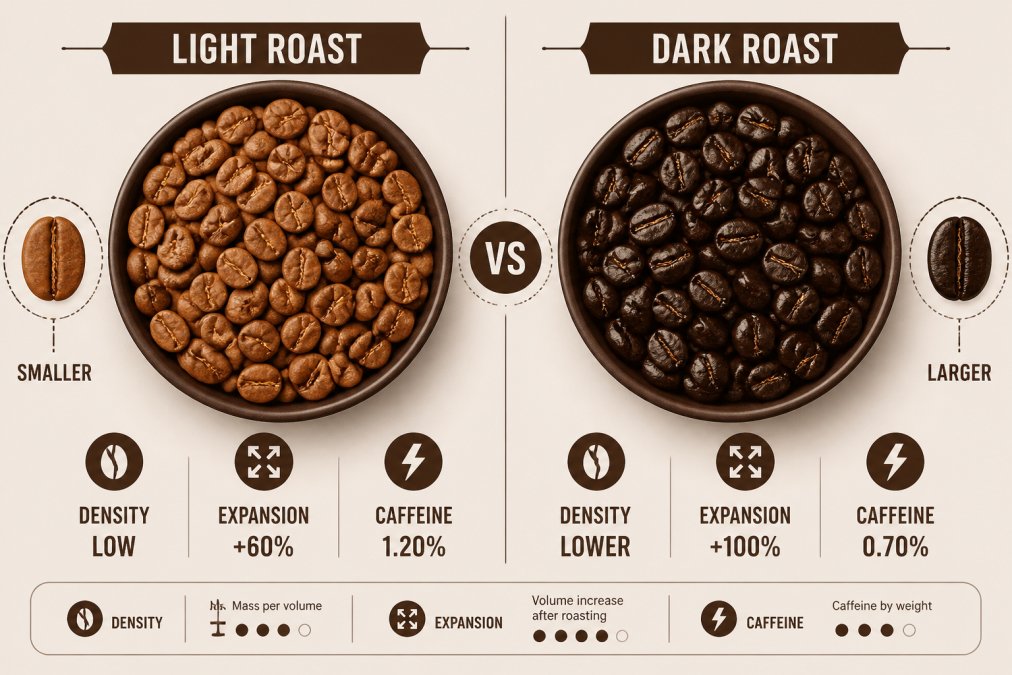
What does change is bean density. Light roast beans are denser than dark roast beans. A dark roast bean has expanded more, lost some internal structure, and weighs slightly less. This matters enormously when you measure coffee by volume rather than by weight, a scoop of light roast contains more actual coffee matter than a scoop of dark roast.

If you measure by weight (grams), light roast and dark roast deliver nearly identical caffeine. If you measure by volume (scoops), light roast delivers more caffeine per scoop, simply because more bean material fits in the same space.
Understanding Caffeine Content in Different Coffee Brewing Methods
Brewing method matters far more than roast degree when it comes to how much caffeine ends up in your cup. Different brewing techniques extract caffeine at different rates, and the contact time between water and coffee grounds is the primary driver.
Drip Coffee
Drip coffee makers use hot water that passes through grounds for 4-6 minutes. This moderate contact time extracts a moderate amount of caffeine, typically around 95-200 milligrams per 8-ounce cup, depending on how much coffee you use and how long the water actually contacts the grounds.
The caffeine concentration remains relatively consistent between light and dark roasts when you control for the amount of coffee used. A drip brew with 15 grams of light roast delivers roughly the same caffeine as 15 grams of dark roast, because the extraction yield is similar for both.
What changes is the flavor profile and how the caffeine feels. The acidity in light roast coffee can make the caffeine feel more pronounced, your body absorbs it slightly faster, and the brightness of the cup amplifies the stimulant effect psychologically.
French Press
French press brewing uses immersion, the grounds sit in hot water for 4 minutes, then you press down a metal filter. This longer contact time extracts more total caffeine than drip coffee, often reaching 80-135 milligrams per 4-ounce cup.
The metal filter in a French press allows more coffee oils and fine particles through compared to paper filters. These oils contain compounds that can enhance caffeine absorption. The result is a fuller-bodied cup with a more pronounced caffeine kick, regardless of roast degree.
Dark roast beans in a French press tend to produce a heavier, more syrupy mouthfeel. Light roast beans produce a brighter cup with more acidity. Neither delivers significantly more or less caffeine per gram of coffee used.
Espresso
Espresso is the exception that proves the rule. High-pressure water forced through finely-ground coffee for 25-30 seconds extracts caffeine very efficiently. A single espresso shot (1 ounce) contains roughly 63-75 milligrams of caffeine, less total caffeine than a cup of drip coffee, but highly concentrated.
The extraction yield in espresso is actually quite high because of the pressure and the fine grind size. But because the volume is small, the total caffeine is modest. Two shots (a double) deliver roughly the caffeine of a standard cup of drip coffee.
Roast degree affects espresso flavor significantly, dark roast espresso tastes heavier and more bitter, while light roast espresso tastes brighter and more acidic. The caffeine content per shot remains nearly identical.
Factors Affecting Caffeine Levels in Coffee
Beyond roast degree and brewing method, several variables shape how much caffeine you actually extract and absorb.
Light Roast Coffee Bundle | 4 bags →
Bean Density and Mass vs Volume
Bean density is the hidden variable in the roast-versus-caffeine debate. Light roast beans are denser. A light roast bean is denser and heavier. A dark roast bean is lighter and more porous.
This density difference is why volume measurements (scoops, tablespoons) are unreliable. A scoop of light roast whole beans contains more actual coffee matter than a scoop of dark roast. If you use the same volume of each, you're actually using different weights, and therefore different amounts of caffeine.
Mass-based measurement (grams) eliminates this problem entirely. Fifteen grams of light roast and 15 grams of dark roast contain nearly identical caffeine, because you're measuring the actual coffee matter, not the air space between expanded beans.
Extraction Yield and Water Temperature
Extraction yield is the percentage of the coffee's soluble solids that dissolve into your water. Higher extraction yields mean more caffeine in your cup. Water temperature is the primary control: hotter water extracts caffeine more efficiently than cooler water.
Light roast coffee often requires slightly hotter water to extract properly, while dark roast can be brewed at slightly lower temperatures without losing flavor. This difference is small but measurable, a few degrees can shift extraction yield by 1-2 percentage points.
Brewing time also affects extraction. Longer contact time allows more caffeine to dissolve. Drip coffee left sitting for 10 minutes extracts more caffeine than drip coffee brewed for 5 minutes, though the flavor deteriorates as over-extraction occurs.
Caffeine Stability During Storage
Caffeine is stable during roasting and stable during storage. It doesn't degrade significantly at room temperature over weeks or months. What does degrade is flavor, the volatile compounds that create taste and aroma fade over time.
Whole beans preserve caffeine and flavor longer than ground coffee. Once you grind beans, you increase the surface area exposed to oxygen, and aromatic compounds escape more rapidly. A bag of whole beans stays fresher for 3-4 weeks after roasting. Ground coffee begins noticeably declining within 1-2 weeks.
Storage conditions matter. Cool, dark, airtight containers preserve both flavor and caffeine stability better than countertop jars or bags left open. Freezing whole beans extends freshness, though the practice is debated among coffee professionals, the freeze-thaw cycle can introduce moisture that degrades flavor.
How Roast Degree Affects Caffeine Potency
Roast degree doesn't significantly alter the total caffeine content, but it does affect how your body experiences that caffeine. Light roast coffee contains more chlorogenic acids and other compounds that enhance caffeine absorption. These acids are partially degraded, which can make dark roast coffee feel slightly less stimulating despite containing nearly identical caffeine.
Light roast coffee's brightness and acidity create a perception of higher caffeine content.
Flavor Profiles and Caffeine Perception
Light roast coffee emphasizes the origin characteristics of the beans. Floral notes, fruit flavors, and bright acidity come through clearly. This brightness creates a perception of higher caffeine content, your nervous system responds to the acidity and the sensory stimulation.
Which Roast Should You Choose
Choose light roast if you prefer bright, acidic coffee with origin-forward flavors. Light roast emphasizes what makes each region's beans unique. The caffeine content is identical to dark roast by weight, but the acidity and flavor intensity create a perception of higher stimulation.
| Factor | Light Roast | Dark Roast |
|---|---|---|
| Caffeine by Weight | Nearly identical | Nearly identical |
| Caffeine by Volume | Higher (denser beans) | Lower (more expanded beans) |
| Flavor Profile | Bright, fruity, acidic | Bold, chocolatey, smooth |
| Best Brewing Method | Drip, pour-over | French press, espresso |
| Extraction Difficulty | Requires precise temperature | More forgiving |
| Storage Life | 3-4 weeks (whole bean) | 3-4 weeks (whole bean) |
Frequently Asked Questions
Does light roast coffee actually have more caffeine than dark roast?
The difference is minimal. Light roast beans retain slightly more caffeine by weight. However, when measured by volume or scoop, the difference becomes negligible. What matters far more is how much coffee you use and your brewing method. A light roast brewed for 4 minutes and a dark roast brewed for 3 minutes can deliver similar caffeine levels to your cup.
How does the measurement method affect caffeine perception?
This is where confusion starts. By weight, light roast has slightly more caffeine per gram because beans are denser. By volume (per scoop), the difference nearly disappears, dark roast beans expand more, so a scoop contains fewer beans but roughly equal caffeine. Most home brewers measure by scoop or weight casually, which explains why people perceive the difference as larger than it actually is.
What factors affect caffeine levels in coffee more than roast level?
Brewing method, water temperature, and contact time matter more than roast degree. French press extracts more caffeine than drip coffee because the grounds steep longer in hot water. Espresso delivers high caffeine concentration in a small volume due to pressure and extraction yield. Bean origin, freshness, and grind size also influence how much caffeine ends up in your cup, often more significantly than whether you choose light or dark roast.
How much caffeine is in a standard cup of coffee?
A typical cup of drip coffee contains a range of caffeine, depending on brew strength and bean type. Espresso delivers a concentrated amount of caffeine per shot. French press typically yields a moderate amount per cup. The variation within each method often exceeds the variation between roasts.


