
Last Updated: October 29, 2026
Quick Summary
Sustainable coffee farming is growing coffee in a way that keeps the land productive, protects the people who work it, and still turns a profit for the farm. Beginners can start with shade trees, compost, cover crops, and water-saving washing, then build from there season by season.
- Every sustainable farm balances three things: environment, economics, and community.
- Shade-grown coffee usually yields less per hectare but can produce denser flavor in the cup.
- Composting coffee pulp, weeds, and manure cuts the need for synthetic fertilizers over time.
- Eco-pulp machines and mechanical demucilagers sharply cut water use during washing.
- Certification is farm-level, not bag-level, so check the certifier's name and certificate code.
Table of Contents
- What Sustainable Coffee Farming Means in Plain Terms
- Shade-Grown Coffee Benefits for Farms and Wildlife
- Coffee Farm Soil Conservation: Cover, Compost, and Erosion Control
- Water Conservation in Coffee Farming, From Washing to Irrigation
- Sustainable Coffee Certifications and How to Read Them
- What It Costs a Beginner to Farm This Way
- Start With a Bag You Can Trace
- Frequently Asked Questions
What Sustainable Coffee Farming Means in Plain Terms
Sustainable coffee farming is the practice of growing coffee in a way that keeps the land productive, protects the people who work it, and still turns a profit for the farm. A farm that fails at any one of them rarely lasts.
The idea sounds soft until you look at what it replaces. Conventional coffee growing can strip soil, clear shade trees, and leave growers exposed to price swings they cannot control. Sustainable coffee farming practices explained for beginners come down to a simple question: can this farm still grow good coffee here in ten years?
The Three Things Every Sustainable Farm Balances
Every sustainable coffee farming decision trades off three things:
- Environment: soil, water, trees, and wildlife on the land
- Economics: whether the grower earns enough to keep going
- Community: fair pay, safe work, and schools or clinics nearby
Push too hard on one and the others suffer. A farm that plants trees but cannot sell its crop will cut them down next season. Keep that balance in mind as we walk through each practice below.
Shade-Grown Coffee Benefits for Farms and Wildlife
Shade-grown coffee is grown under a canopy of taller trees instead of in full sun. The benefits are practical, not just pretty: cooler soil, slower ripening, and habitat for birds and insects that would otherwise have nowhere to live.
A shade canopy does real work for the grower (ch03). It holds moisture in the soil, cuts erosion on steep hillsides, and shields coffee shrubs from harsh afternoon heat.
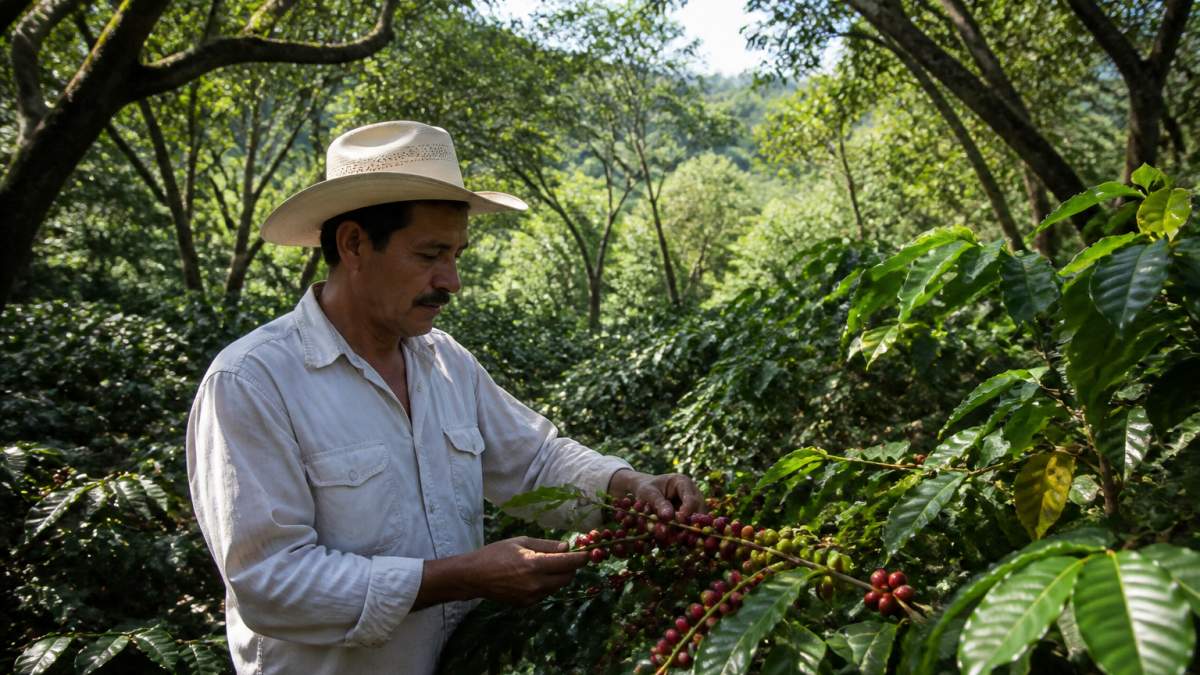
The trade-off is speed. Shade-grown coffee cherries ripen more slowly, which often means lower yield per hectare but denser flavor in the cup. To connect growing conditions with what you taste, explore coffee tasting notes by region.
Coffee Farm Soil Conservation: Cover, Compost, and Erosion Control
Coffee farm soil conservation is the set of practices that keep topsoil where it belongs, on the farm rather than in the river. Three tools do most of the work: ground cover, compost, and erosion control.
Ground cover means keeping something growing between the coffee rows. A cover crop like beans or grasses holds soil in place during heavy rain and adds organic matter when it breaks down.
Compost turns coffee pulp, weeds, and manure into fertilizer. Many farms use vermicomposting, where worms break down the material into a rich, dark amendment.
Erosion control matters most on slopes. Contour planting, mulch, and small trenches slow water down before it can carry soil away.
A common mistake is treating compost as an afterthought. In practice, the farms that build a steady composting habit see the biggest gains in soil fertility within a few seasons.
Water Conservation in Coffee Farming, From Washing to Irrigation
Water conservation in coffee farming means using less water at every stage, from processing the cherries to irrigating the trees. The washing step is usually the biggest user, so it is the first place to look.
Traditional wet processing can consume large volumes of water. Many farms now use eco-pulp machines or mechanical demucilagers that cut water use sharply during washing. Others recirculate water through settling tanks rather than letting it run once and drain away.
On the growing side, drip irrigation and mulching reduce how much water the trees need in the first place. Shade trees help here too, since they slow evaporation from the soil.
Watch out: over-irrigating to chase a bigger crop can waterlog roots and invite disease. The farms that get this right measure soil moisture before they turn on the tap.
Sustainable Coffee Certifications and How to Read Them
Sustainable coffee certifications are third-party labels that verify a farm meets specific environmental or social standards. They are useful shorthand, but they are not all the same, and reading them closely matters more than counting logos on a bag.
A plain-language comparison of the main schemes, and what each one actually checks:
| Certification | What It Verifies | What It Does Not Guarantee | Best For |
|---|---|---|---|
| Organic (Canada Organic Regime) | No prohibited synthetic pesticides or fertilizers; verified by a certifier accredited under the Canadian Organic Regime | Fair pay, shade, or biodiversity | Buyers avoiding chemical inputs |
| Fairtrade | Minimum price, fair labor terms, and a social premium for community projects | Specific environmental practices or shade cover | Supporting farmer livelihoods |
| Rainforest Alliance | Shade, biodiversity, farm management, and worker conditions against a standard | Organic status or a fixed minimum price | Wildlife and habitat protection |
| Bird Friendly | Shade canopy structure and habitat criteria set by the Smithsonian Migratory Bird Center | Labor terms or price | Habitat-focused buyers |
A few things beginners should know before trusting a label:
- Certification is farm-level, not bag-level. A roaster can buy certified green coffee and blend it with uncertified coffee; only a product carrying the mark itself is verified. Look for the certifier's name and the certificate code, not just a logo.
- Schemes audit different things. Organic audits inputs. Fairtrade audits price and labor (Fairtrade Standards). Rainforest Alliance audits management and habitat. A farm can hold one and not another, so a single label never tells the full story.
- Certification costs money and time. Audits, record-keeping, and annual fees are real burdens for smallholders, which is why many excellent farms are uncertified. Absence of a label is not evidence of poor practice.
- Watch for broad claims. Phrases like "sustainably sourced" or "eco-friendly" are marketing language, not verified standards. If a bag makes a sustainability claim without a named certifier, treat it as unverified.
What It Costs a Beginner to Farm This Way
The honest answer is that sustainable methods usually cost more up front and pay back over years, not months. A beginner should plan for that gap, and plan the sequence, because doing everything at once is the most common way new growers stall.
A Starter Sequence for the First Three Seasons
Most practitioners find that a staged approach beats an overhaul. A common pattern looks like this:
- Season one, measure and stabilize. Map the slope, check soil pH, note where water pools, and record current yields and input use. Start a compost pile with coffee pulp and weeds. Keep existing shade trees rather than clearing them.
- Season two, build soil and cover. Plant a cover crop between rows, add mulch on exposed slopes, and cut synthetic fertilizer gradually as compost comes online. Begin contour planting or small trenches on the steepest ground.
- Season three, diversify and protect water. Add native shade trees in gaps, install drip lines or mulch basins where irrigation is needed, and switch to water-saving washing equipment if processing on site.
What the Main Costs Are
Building compost, planting shade trees, and switching to water-saving washing all take work before they show results. Shade trees in particular may take several seasons to mature and deliver their full benefit.
Simple Indicators to Track
You do not need a lab to know whether the changes are working. Track a handful of simple indicators each season and compare them year over year:
- Soil cover: the percentage of ground between rows that is covered by plants or mulch at the end of the rainy season.
- Water use: liters used per unit of cherry washed, or hours of irrigation per week.
- Tree diversity: the number of native shade species on the plot.
- Input use: bags of synthetic fertilizer and liters of pesticide applied per hectare.
- Yield: kilograms of cherry per hectare, recorded consistently.
- Income: net income per hectare after input costs.
The trade-offs are real and context-specific. If you are weighing why specialty coffee costs more than grocery, the costs above explain where the money goes. A farm with rich soil and steady rain will get further with compost alone than a dry, sloping farm that needs irrigation and erosion work first. If you are weighing why responsibly grown coffee carries a higher price at retail,
Start With a Bag You Can Trace
Traceability is the simplest way for a beginner to support sustainable coffee farming without visiting a farm. If you can follow a bag back to a region, a process, and a certification, you can judge the claims for yourself.
We built our collection around that idea. Our Peru Cajamarca FTO is a medium-dark roast, certified organic and Fair Trade, grown at 1,000 to 2,050 meters and washed for clarity, with notes of stone fruit, honey, and raisin. Our Sumatra G1 carries USDA certification and offers a wet-hulled depth of syrupy, dark chocolate notes with a smoky finish.

Start with one bag you can trace, brew it slowly, and taste the difference for yourself. You can also browse coffee types to compare origins and options.
Frequently Asked Questions
What does sustainable coffee farming mean?
It means growing coffee in a way that can continue indefinitely without depleting the land or the people working it. In practice that covers keeping soil covered and fertile, growing coffee under shade trees, cutting unnecessary chemical inputs, using water carefully, and paying farmworkers enough to stay in the business. No single practice makes a farm sustainable; it is the combination held together over years. For a beginner, the simplest way to judge it is to ask what the farm does about soil, shade, water, and waste, and whether anyone can verify the answers.
How does shade-grown coffee benefit the environment?
Shade-grown coffee benefits go beyond the cup. Shade trees and taller native trees hold soil on slopes during heavy rain, drop leaf litter that feeds soil fertility, and create habitat for birds, insects, and pollinators that would otherwise have nowhere to live on a cleared field. The canopy also moderates temperature, which matters as growing conditions shift. On the farm itself, shade reduces sunlight exposure on the coffee shrubs and slows evaporation, so the plants stress less in dry spells. The trade-off is management: shade trees need pruning so they do not outcompete the coffee for light and water.
How do coffee farmers conserve water?
Water conservation in coffee farming starts with how the cherries are processed. Washed processing uses large volumes of water, so farms that recirculate or reduce that water, or switch to methods that need less, cut consumption sharply. On the growing side, mulching with coffee pulp and other organic matter keeps moisture in the soil, and shade cover reduces evaporation. Catchment tanks and drip lines replace broad spraying. For a beginner, the practical first step is measuring how much water a batch actually uses, because most waste is invisible until someone counts it.
What is the difference between sustainable coffee and fair trade coffee?
Sustainable coffee is about how the crop is grown: soil, shade, water, biodiversity, and long-term farm viability. Fair trade is about the trading relationship, mainly a minimum price and a premium paid to cooperatives, plus rules on labor. They overlap but are not the same claim, and a bag can carry one without the other. Sustainable coffee certifications such as organic, Rainforest Alliance, and Fair Trade each verify a different slice of the picture. When you are choosing, read which standard is on the bag rather than trusting a general word like ethical.
The gap between a label and a real farming practice is where most buyers get stuck. We close it by sourcing single-origin beans with the certifications and origin details printed where you can check them, from organic Peruvian highlands coffee to wet-hulled Sumatran lots. Get started with Gilded Grind and taste what traceable, responsibly grown coffee brings to your morning ritual.


