
Last Updated: November 5, 2026
Quick Summary
To calculate cost per cup, divide your bag price by the bag weight in grams, then multiply by your dose in grams. A 1 kg bag at $60.00 costs $0.06 per gram, so an 18 gram dose comes to $1.08 in beans.
- Add milk, filters, water, equipment share and waste to bean cost for a true total.
- A 1,000 gram bag dosed at 18 grams per cup yields about 55 cups.
- Spread equipment cost across expected lifetime cups, such as 2,190 cups over three years.
- Espresso, pour-over, drip and French press each use different doses and bean costs.
- Two $1.50 daily cups cost about $1,095.00 a year versus $2,555.00 at a café.
Table of Contents
- Why Calculating Cost Per Cup for Home Coffee Pays Off
- The Core Formula: Cost of Coffee Beans Per Cup
- Getting the Coffee-to-Water Ratio Right
- Building Your Own Coffee Cost Per Cup Calculator
- Beyond Beans: Milk, Add-Ins, Filters, and Equipment
- What It Really Costs to Make Coffee at Home
- Comparing Brew Methods and Daily Coffee Spend
- Stock Your Shelf and Start Brewing
- Frequently Asked Questions
Why Calculating Cost Per Cup for Home Coffee Pays Off
Calculating cost per cup for home coffee turns a vague daily habit into a number you can work with.
Most guides stop at the beans. Beans are a major line item, but milk, filters, and gear all add to your budget, so a complete calculator counts everything.
Below, we walk through the formula, worked examples, and a simple calculator you can rebuild in a spreadsheet tonight.
The Core Formula: Cost of Coffee Beans Per Cup
The cost of coffee beans per cup equals your bag price divided by the grams in the bag, multiplied by the grams you dose.
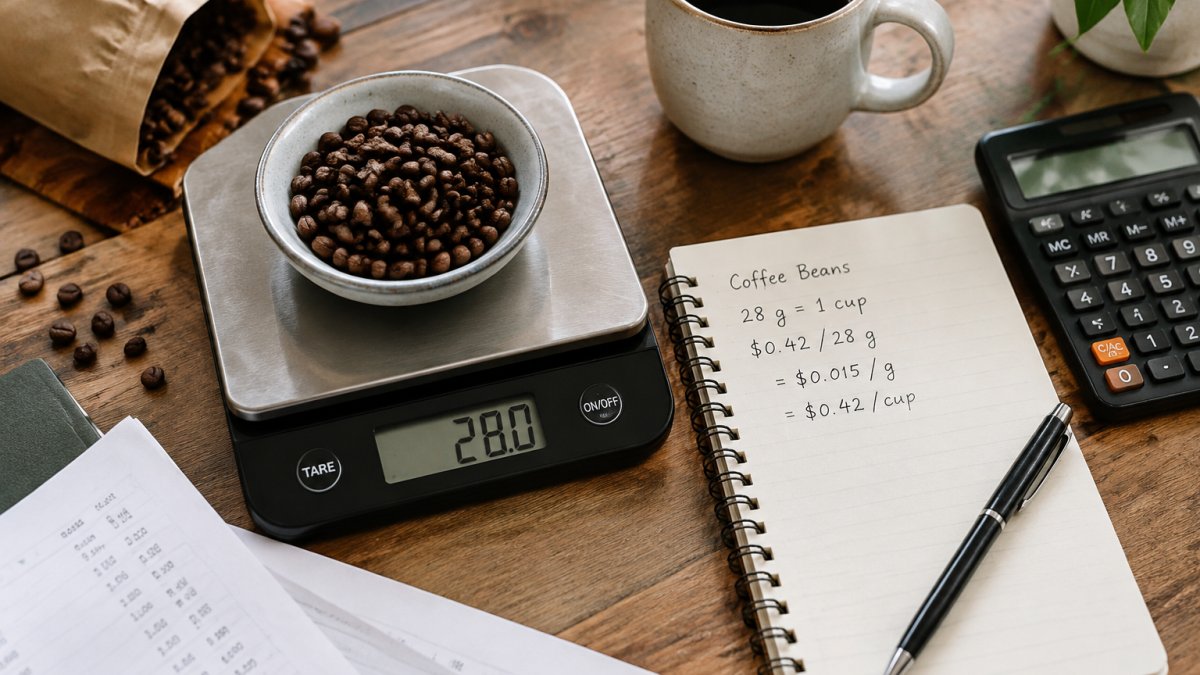
Written out, it looks like this:
Cost per cup = (bag price ÷ bag weight in grams) × dose in grams
A 1 kg bag holds 1,000 grams. At $60.00, your cost per gram is $0.06. Dose 18 grams and the beans cost you $1.08.
That single line is the engine of every coffee cost per cup calculator worth using.
Bean Price, Bag Weight, and Cost Per Gram
Start with two honest numbers: what you paid and what the bag weighs. Check the label rather than guessing, because bag weights vary more than people expect.
Our 1 kg whole bean bag gives you a clean starting point: a known weight and a known price to drop straight into the formula.

Divide price by grams and you have your cost per gram. Write it down, you will reuse it all year.
Dose Size and Cups Per Bag
Dose is how many grams of ground coffee go into your brewer for one cup. Dose is a matter of method and taste, so weigh what suits your brewer.
To find cups per bag, divide bag weight by dose. A 1,000 gram bag at 18 grams per cup yields about 55 cups.
Getting the Coffee-to-Water Ratio Right
The coffee-to-water ratio decides how far your beans stretch and how the cup tastes. A ratio of 1:16 means one part coffee to sixteen parts water.
Get this wrong and two things happen. Use too little coffee and the cup tastes thin, so you dose heavier to compensate. Use too much and you burn through a bag in half the time.
Weigh your water once, then trust the numbers. Our guide to brewing better coffee at home lists exact ratios and water temperatures for each method.
A kitchen scale removes the guesswork. Scoops vary wildly; grams do not.
Building Your Own Coffee Cost Per Cup Calculator
Building a coffee cost per cup calculator takes four columns and one formula. Open a spreadsheet and set it up like this:
- Column A: Bag price
- Column B: Bag weight in grams
- Column C: Dose in grams
That is your bean cost per cup. Add a fifth column for add-ins and a sixth for equipment share, and you have a full picture.
Save a copy for each brew method you use. Change the dose, and the sheet recalculates.
Here is the assumption checklist we use before trusting any result:
- Bag price includes tax and shipping
- Bag weight is in grams, not ounces
- Dose is weighed, not scooped
Get those five right and your estimate lands close to reality. Skip one and the number drifts.
Beyond Beans: Milk, Add-Ins, Filters, and Equipment
Beans are not the whole bill. Milk, sweetener, filters, water, and gear all add to the true cost to make coffee at home. Ignore them and you undercount by a meaningful margin, often by more than the bean cost itself on milk-heavy drinks.
The complete formula is a sum of five lines, not one:
Total cost per cup = bean cost + milk and add-ins + filter and water + equipment share + waste allowance
Each line is calculated separately, then added. Here is how to build each one with numbers you can check.
Milk and Add-Ins, Priced Per Cup
Milk is the big one for anyone drinking lattes or flat whites. Track how much you pour per cup, then multiply by your milk price per liter.
A splash in a drip coffee is roughly 15-30 ml. A latte pour is closer to 150-200 ml.
Sweeteners and syrups are easy to forget. A pump of syrup is often about 10-15 ml; at a typical bottle price, that is a few cents per cup.
Filters, Water, and the Small Stuff
Paper filters run a few cents per brew. A box of 100 filters at a typical price works out to roughly $0.03-$0.06 per cup depending on the brand and size.
Water matters if you buy bottled or use a filtered pitcher.
Descaling and cleaning supplies are small but real. A bag of descaler used every few months adds a few cents per cup at most; count it if you want the number to be honest.
Allocating Equipment Cost and Finding Break-Even
Equipment is a one-time cost, so spread it across the cups it will make. Divide the brewer's price by the number of cups you expect from it before replacing it.
A $200.00 brewer making two cups a day for three years covers roughly 2,190 cups. That is about $0.09 per cup. A $150.00 grinder used for the same 2,190 cups adds about $0.07 per cup.
The break-even point is where your home cost per cup meets the café price you would otherwise pay.
Watch out: spreading equipment over an unrealistic lifetime, say, ten cups a day for a decade, makes the gear share look artificially tiny. Use the number of cups you actually expect to brew.
Waste and Leftover Coffee
Waste is the line almost every guide skips. If you brew a pot and pour out the last cup, that coffee still cost you money.
A simple method: if you brew 10 cups a week and pour out one, your effective cost per drunk cup is about 10% higher than your calculated cost. Adjust your dose or batch size rather than accepting the waste.
What It Really Costs to Make Coffee at Home
A realistic home-brewed cup lands well below café prices once you count everything.
Here is how the pieces stack up for a typical mug:
| Cost component | What to count | Typical share |
|---|---|---|
| Beans | Price ÷ weight × dose | Largest share |
| Milk and add-ins | Per-cup pour × price per liter | Varies by drink |
| Filters and water | Per brew | Small |
| Equipment | Price ÷ lifetime cups | Small, fixed |
New brewers often worry the setup costs too much to justify. Our guide to affordable coffee bundles for new home brewers shows how to keep the per-cup number low from day one.
Comparing Brew Methods and Daily Coffee Spend
Brew method changes your dose, and dose changes your cost per cup. Espresso uses a small, dense dose. Drip and pour-over use more water and a larger bed of grounds.
The table below converts each method into a bean cost per cup using a single reference bean price of $60.00 per 1 kg bag, or $0.06 per gram.
| Method | Typical dose | Cups per 1 kg bag | Bean cost per cup | Equipment share (example) |
|---|---|---|---|---|
| Espresso | 18 g | ~55 | $1.08 | ~$0.20 (machine + grinder over 2,190 cups) |
| Pour-over | 18-22 g | ~45-55 | $1.08-$1.32 | ~$0.05 (dripper + kettle) |
| Drip | 20-25 g | ~40-50 | $1.20-$1.50 | ~$0.09 (brewer) |
| French press | 25-30 g | ~33-40 | $1.50-$1.80 | ~$0.03 (press) |
The equipment share column is illustrative, not universal.
Worked Examples for Four Methods
Drip, one mug: 22 g dose at $0.06 per gram = $1.32 beans. Filter $0.04.
Pour-over, one mug: 20 g dose = $1.20 beans. Filter $0.04. Water $0.02. Equipment $0.05. No milk.
French press, two mugs from one brew: 55 g dose = $3.30 beans for two cups, or $1.65 each. No filter. Water $0.02.
Espresso, one shot: 18 g dose = $1.08 beans. Water $0.01. Equipment $0.20.
These are reference numbers, not promises. Your bag price, dose, and gear will move them.
Daily, Monthly, and Annual Spend
Multiply your daily cups by your cost per cup and you have your daily coffee spend. Times thirty gives you the month. Times twelve gives you the year.
At two $1.50 cups a day, that is $3.00 daily, about $90.00 a month, and about $1,095.00 a year. The same two drinks at a café at $3.50 each would be $7.00 daily, about $210.00 a month, and about $2,555.00 a year.
Sensitivity: What Moves the Number Most
A small change in one input can swing the annual figure more than you expect. Run these three what-ifs on your own spreadsheet:
- Bean price: moving from $40.00 to $60.00 per kg raises a 20 g cup from $0.80 to $1.20 in beans, a 50% jump in the largest line.
- Dose: going from 18 g to 22 g raises bean cost by about 22% for the same bag.
- Daily cups: going from one to two cups doubles every per-day, per-month, and per-year figure, including the café comparison.
Watch out: comparing a home cup that includes milk and equipment against a café price that excludes tax and tip understates the savings. Compare like with like.
If you want to know whether a subscription beats buying bags outright, our breakdown of whether a coffee subscription is worth the cost compares price per cup directly.
Stock Your Shelf and Start Brewing
You now have the formula, the assumptions, and the calculator. Browse our available coffee types to find the origin and profile that fits your routine.
At Gilded Grind, our beans are 100% Arabica. Each bag carries its own character.
A few things to keep in mind as you shop:
- Buy a weight you will finish while the coffee still tastes fresh
- Store beans sealed and away from light and heat
- Weigh your dose each time so your cost math stays true
Best for: brewers who want a known weight and price to plug into the formula. Skip if: you prefer single-serve pour-over bags for travel.
Frequently Asked Questions
How do you calculate the cost per cup of coffee at home?
Divide the bag price by the bag weight in grams to get a cost per gram. Multiply that by the dose you use per cup, usually 10 to 18 grams depending on brew method, then add milk, filters, and a share of equipment cost. For example, a $60 1 kg bag works out to $0.06 per gram, so a 15 g dose costs about $0.90 in beans before add-ins.
Should you include filters and other supplies in the cost per cup?
Yes, if you want an honest number. Paper filters, water, and any sweetener or milk all add up over a month. A filter costs a few cents per brew, and milk can add more than the beans themselves. Track these separately so you can see which line item is driving your daily coffee spend and adjust from there.
Does the brewing method change the cost per cup?
It changes the dose and the equipment cost, not the bean price per gram. Espresso uses a concentrated 18 g dose, drip and pour-over typically use 15 to 20 g per 250 ml cup, and a single-serve pour-over bag is priced per unit. Equipment cost spread over hundreds of brews also shifts the total, so compare methods on a full monthly cost rather than beans alone.
How can you compare the cost of different coffee beans per cup?
Normalize everything to cost per gram, then apply your usual dose. Normalize each bag to cost per gram, then compare the two by how many cups each bag yields. Factor in how many cups each bag yields and whether the flavor profile suits your daily brew before deciding.
The math is simple, but the habit is what saves money. Weigh your dose, track your bag price, and let the numbers guide your next purchase. Gilded Grind offers freshly roasted whole beans, a range of roast profiles from light to dark, and convenient bundles that keep your cost per cup predictable. Get started with Gilded Grind and brew a cup you can cost to the cent.


