
Table of Contents
- Driftaway Coffee vs Premium Artisanal Roasts: The Quick Comparison
- What Makes Driftaway Coffee Unique?
- The Best Coffee Subscription for Variety: Curated Collections vs Rotating Menus
- Evaluating Coffee Quality at Home: Cupping Scores, Freshness, and Tasting Notes
- How to Choose Premium Coffee Beans: A Practical Framework
- Cost-Per-Cup Analysis: Subscription Convenience vs Artisanal Value
- Troubleshooting Common Brewing Issues with Premium Beans
- Conclusion: Which Approach Fits Your Coffee Ritual?
- Frequently Asked Questions
Last Updated: September 14, 2026
Driftaway Coffee vs Premium Artisanal Roasts: The Quick Comparison
Driftaway Coffee is a subscription service built around a rotating menu of single-origin beans matched to your taste preferences. Premium artisanal roasts are small-batch lots sold as fixed offerings, often with published roast dates and cupping scores. This guide breaks down where each approach wins and how to decide which belongs in your kitchen.
The core tension is algorithmic variety versus curated craft: one model optimizes for discovery, the other for a specific bean from a specific farm.
Winner for variety seekers: Driftaway Coffee. Winner for connoisseurs who want to know exactly what they're drinking: premium artisanal roasts. Choose based on whether you value surprise or traceability.
Here's the comparison at a glance:
| Factor | Driftaway Coffee | Premium Artisanal Roasts |
|---|---|---|
| Model | Rotating subscription menu | Fixed small-batch lots |
| Selection logic | Taste-profile matching | Curated by origin and lot |
| Freshness signal | Roast date on bag | Roast date and lot number |
| Best for | Discovery and convenience | Traceability and repeat buys |
| Commitment | Ongoing subscription | One-time purchase |
What Makes Driftaway Coffee Unique?
Driftaway Coffee's defining feature is its preference-based matching system. New subscribers complete a taste quiz, then receive beans chosen to align with their stated preferences for acidity, body, and flavor intensity. The menu rotates, so subscribers rarely receive the same origin twice in a row.
That rotation removes the decision fatigue of choosing between dozens of single-origin lots. For someone who wants to explore bean variety without researching every purchase, the model works well.
The trade-off is control: you're trusting the matching logic rather than selecting a specific farm or lot. If you already know exactly what you want, a rotating menu adds friction rather than removing it.
The Best Coffee Subscription for Variety: Curated Collections vs Rotating Menus
The best coffee subscription for variety depends on whether you want someone else choosing your beans or a fixed set you work through at your own pace. Rotating menus maximize surprise. Curated collections maximize range within a single purchase.
How Curated Bundles Compare to Algorithm-Driven Selections
A rotating menu delivers one or two origins at a time. A curated bundle delivers several at once, letting you compare them side by side in the same week.
That side-by-side comparison matters more than most people expect. Tasting a Colombian dark roast next to a Sumatran one on consecutive mornings trains your palate far faster than drinking them months apart. Gilded Grind's Global Coffee Collection bundles six origins for exactly this reason.
For gift-givers, bundles also solve a practical problem. A subscription requires the recipient to manage an ongoing account. A one-time collection doesn't.
Evaluating Coffee Quality at Home: Cupping Scores, Freshness, and Tasting Notes
Evaluating coffee quality at home comes down to three signals you can check without special equipment: the roast date, the origin disclosure, and whether the roaster publishes tasting notes you can verify against your own cup.
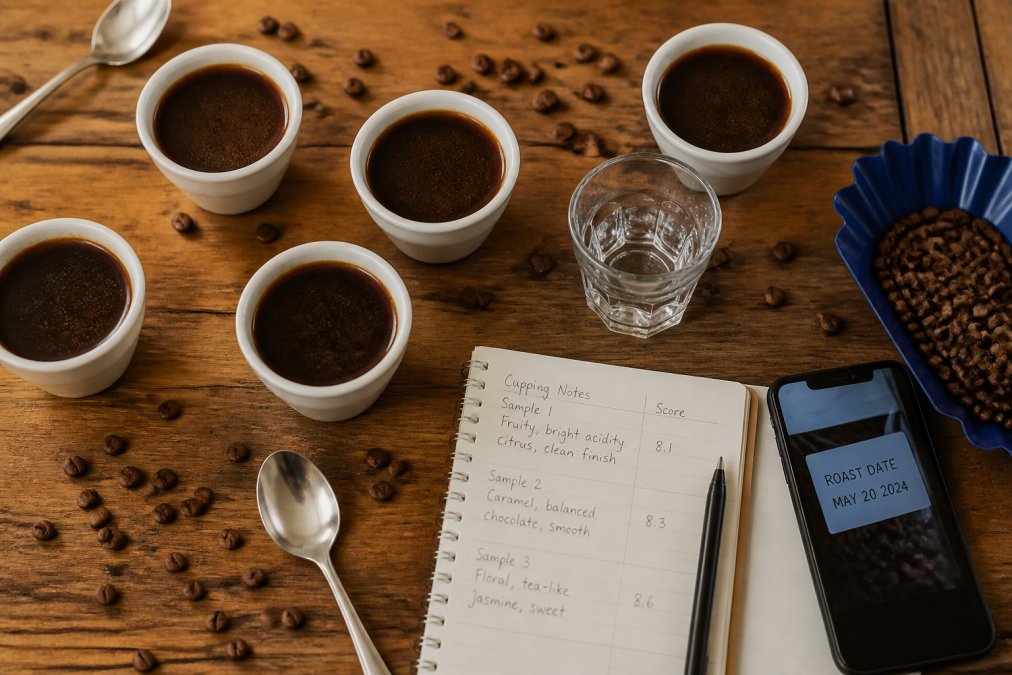
A Three-Axis Sensory Scorecard You Can Run in Ten Minutes
- Acidity (brightness): Does the cup taste crisp and fruit-forward, or muted and round? Light and medium roasts typically score higher here; dark roasts suppress it.
- Body (mouthfeel): Is it thin like tea, or syrupy like whole milk? Wet-hulled beans and dark roast profiles tend to sit at the heavy end.
- Sweetness (perceived, not added): Does the finish carry caramel, brown sugar, or fruit sweetness, or does it land bitter and dry?
How Subscription Beans and Artisanal Lots Score Differently
A rotating subscription optimizes for variety, so the sensory profile shifts shipment to shipment. That makes benchmarking harder: you rarely get the same bean twice to confirm a score. Artisanal single-lot offerings are the opposite, because the lot is fixed, you can re-buy the same bean, re-score it, and track how it changes over time.
Reading Roast Dates, Certifications, and Origin Transparency
A roast date tells you more than a best-before date ever will. Beans peak in flavor within a few weeks of roasting, so the gap between roast date and your brew day is the single most useful freshness measure on the bag. A best-before date is a shelf-life statement, not a freshness one.
Certifications are the second signal. In Canada, organic claims on food labels are regulated, and a certified organic mark has been verified against a defined standard rather than self-declared. Gilded Grind's Sumatra G1 carries USDA organic certification, which is verifiable rather than a marketing line.

Origin transparency is the third. A bag that names the region and grade gives you something to compare against; a bag that says only "dark roast" does not. When you score two beans on the three axes above, the one with a named region and grade is the one you can re-buy with confidence.
How to Choose Premium Coffee Beans: A Practical Framework
Choosing premium coffee beans starts with matching the bean to how you actually brew.
Use this framework:
- Identify your primary brewing method. Pour-over, espresso, French press, and cold brew each reward different roast levels.
- Decide whole bean or ground. Whole bean keeps flavor longer; ground is convenient but should be used within weeks.
- Check the roast date. Fresher is better, and a printed date beats a vague freshness claim.
- Match roast level to taste. Light roasts emphasize acidity and origin character; dark roasts emphasize body and chocolate notes.
- Confirm origin and certification. Region, grade, and any third-party certification should be stated on the bag.
- Buy the quantity you'll finish. A large bag of beans you drink slowly goes stale before you reach the bottom.
Matching Roast Profiles to Your Brewing Method
Roast profile and brewing method should reinforce each other. Here's how the common pairings work:
- Pour-over: Medium to medium-dark roasts. Low-acidity options keep the cup balanced and let caramel notes come through.
- Espresso: Medium-dark to dark. These roast profiles hold up against pressure and produce a syrupy, chocolate-forward shot.
- French press: Dark roasts, especially wet-hulled beans with heavy body and smoky finish.
- Cold brew: Dark roasts with low acidity, since cold extraction already mutes brightness.
Gilded Grind's Huila Colombia Ground Dark is ground after your order and works across most brewing methods, best with milk. For espresso and French press, the Sumatra G1 USDA Dark whole bean delivers the syrupy body those methods reward.

Cost-Per-Cup Analysis: Subscription Convenience vs Artisanal Value
Cost-per-cup is the honest way to compare a subscription against artisanal beans, because bag price alone hides how many cups you actually get.
The Dose Math Behind Every Cost-Per-Cup Figure
A 340 g bag of whole bean typically yields around 20 to 24 cups. At $22.00 for the Sumatra G1, that lands roughly in the $0.90 to $1.10 per cup range. Gilded Grind's Dark Roast Single-Serve Pour Over is $2.80 per cup, offering convenience without the need for additional equipment or cleanup.

Subscription Economics vs Artisanal Cafe Pricing
Brewing at home from a $22.00 bag can be more cost-effective than purchasing espresso-based drinks from a cafe. This can be a significant financial benefit for buying beans for home brewing.
Subscription services spread cost across recurring shipments, which means a predictable monthly outlay but also a volume you may not finish. Artisanal beans let you buy exactly what you'll drink, but per-bag pricing is often higher because small lots carry higher per-unit costs.
The Costs That Don't Show Up on the Bag
Three costs sit outside the per-cup figure and change the ranking:
- Shipping: Subscriptions often bundle shipping into the plan; one-off artisanal orders frequently add a per-order shipping charge that can add 10 to 25 percent to the effective per-cup cost on a single bag.
- Staleness waste: A large bag you don't finish is money in the compost. Buying smaller quantities more often usually beats a bulk discount once waste is counted.
- Equipment: Single-serve formats carry a higher per-cup price precisely because they remove the grinder, the scale, and the cleanup. If you already own that equipment, the premium is pure convenience, not quality.
| Option | Price | Format | Cost Per Cup |
|---|---|---|---|
| Sumatra G1 USDA Dark | $22.00 | Whole bean | Roughly $0.90-$1.10 |
| Huila Colombia Ground Dark | $16.50 | Ground | Roughly $0.75-$0.90 |
| Pour Over Box Med-Dark | $24.00 | Single-serve drip | Varies by box count |
| Single-Serve Pour Over | $2.80 | Single-serve drip | $2.80 |
Troubleshooting Common Brewing Issues with Premium Beans
If your coffee tastes bitter, sour, or flat, the problem is usually one of five things.
- Bitterness: Water too hot or extraction too long. Drop the temperature and shorten the brew time.
- Sourness: Under-extraction. Grind finer or extend contact time.
- Flat, lifeless cup: Beans past their peak. Check the roast date.
- Inconsistent flavor day to day: Uneven grind size. A consistent grinder fixes more cups than any bean upgrade.
- Weak body: Too little coffee for the water volume. Increase the dose before changing anything else.
Conclusion: Which Approach Fits Your Coffee Ritual?
The real question isn't which model is better; it's whether you want to be surprised or certain. Driftaway Coffee suits drinkers who enjoy discovery and don't want to think about the next order. Premium artisanal roasts suit drinkers who want to know the region, the grade, and the roast date before they commit.
If you fall into the second camp, Gilded Grind offers single-origin lots with published origins, organic certification on the Sumatra G1, and bundles like the Global Coffee Collection when you want range without a subscription. Browse the full collection and build a ritual around beans you can actually trace.
Coffee Association of Canada industry resources
Government of Canada Canadian Food Inspection Agency food labelling guidance
Specialty Coffee Association cupping standards and protocols
Frequently Asked Questions
What makes Driftaway Coffee unique compared to other subscriptions?
Driftaway Coffee uses a taste-preference quiz to match subscribers with beans, then sends rotating single-origin selections from different regions. This differs from fixed curated bundles, where you choose specific origins upfront. The trade-off is discovery versus control: Driftaway introduces you to unfamiliar coffees, while curated collections like Gilded Grind's Global Coffee Collection let you pick six known origins in one order. Neither approach is objectively better; it depends on whether you want surprises or a predictable rotation.
How do I evaluate coffee quality at home without professional equipment?
Start with the roast date on the bag, not the best-before date. Beans peak between 7 and 21 days after roasting. Check for origin transparency: a named region like Huila, Colombia or Sumatra tells you more than a generic country label. When brewing, pay attention to acidity, body, and aftertaste. If the coffee tastes flat or bitter regardless of grind adjustments, the beans may be stale. A simple pour-over or French press is enough to assess flavor complexity.
Is a coffee subscription cheaper than buying premium beans individually?
Not always. Subscription services often include free shipping and occasional discounts, which can lower the per-bag cost. But you may receive beans you did not choose. Buying individual bags from a curated collection, like Gilded Grind's Huila Colombia Ground Dark at $16.50 or Sumatra G1 Organic Whole Bean at $22.00, gives you full control over origin and grind. Calculate cost per cup: a 340-gram bag typically yields 20 to 25 cups, so the per-cup difference between subscription and one-time purchase is often small.
What should I look for when choosing premium coffee beans for home brewing?
Focus on four things: origin specificity, roast date, processing method, and certifications. Single-origin beans from a named region offer clearer tasting notes than blends. A recent roast date matters more than a long shelf life. Processing method (washed, natural, wet-hulled) shapes acidity and body. For example, wet-hulled Sumatra beans tend to have earthy, syrupy notes, while washed Colombian beans are brighter. Certifications like USDA Organic verify farming practices, not flavor, but they signal supply chain transparency.
How does bean origin influence the flavor profile of premium coffee?
Origin determines the baseline flavor before roasting. Ethiopian Yirgacheffe beans typically show floral and citrus notes with high acidity. Colombian Huila beans often carry dark chocolate and blackcurrant with a zesty finish. Sumatra G1 beans, wet-hulled for depth, deliver earthy, syrupy body with smoky undertones. These differences persist across roast levels, though darker roasts mute acidity and amplify bitterness. If you prefer low-acid coffee, choose origins known for body over brightness, like Sumatra or Brazil.
Choosing premium coffee shouldn't require guesswork about freshness, origin, or whether the beans match how you brew. Gilded Grind takes that uncertainty out of the equation with freshly ground and whole bean options, roast profiles spanning light to dark, and curated bundles that let you explore multiple origins without committing to a subscription. Get started with Gilded Grind and build a coffee ritual worth savoring.


