
Last Updated: November 2, 2026
Quick Summary
Eco friendly coffee packaging works when the material matches how your customers actually dispose of it and still protects freshness. Choose compostable film only where industrial composting accepts it, recyclable mono-material only where film collection exists, and high-barrier laminate where shelf life matters most.
- Recyclable, compostable and biodegradable are three different claims and are not interchangeable.
- Unlined kraft paper is porous to oxygen and moisture and needs an inner liner for real shelf life.
- Compostable film needs industrial composting and is rarely accepted curbside.
- Multi-layer laminate offers the highest barrier but is rarely recyclable.
- Test a new bag by filling samples, tasting at intervals and confirming local disposal first.
Table of Contents
- What Eco Friendly Coffee Packaging Actually Means
- Coffee Packaging Materials Compared: Paper, Plastic and Laminates
- Are Compostable Coffee Bags Worth It?
- Recyclable Coffee Packaging: What Your Local Program Accepts
- Sustainable Packaging Certifications You Can Verify
- Barrier Properties: Why Freshness Still Comes First
- How to Switch Packaging Without Losing Freshness or Margin
- Choosing Your Next Bag of Beans
- Frequently Asked Questions
What Eco Friendly Coffee Packaging Actually Means
Eco friendly coffee packaging and sustainability is the practice of choosing bags, closures, and labels that reduce environmental impact across their whole lifecycle while still protecting the beans inside.
That single conflict explains most of the confusion in this category. A bag can be recyclable, compostable, or simply marketed as "green," and those are three different things. Below, we'll show you how to read a packaging claim, compare materials honestly, and switch without losing freshness or margin.
The Three Claims That Get Confused
Recyclable means a facility can process the material into something new. It says nothing about whether your local program accepts it.
Compostable means the material breaks down into usable organic matter under defined conditions, which usually means an industrial facility, not a backyard bin.
Biodegradable means only that the material will eventually break down. No timeline, no residue standard, no guarantee.
A common mistake is treating these as interchangeable. They are not, and a bag that carries one label may fail the other two tests entirely.
Coffee Packaging Materials Compared: Paper, Plastic and Laminates
Paper, plastic, and laminates each solve a different problem: paper wins on end-of-life simplicity, plastic wins on cost and seal strength, and laminates win on barrier performance. Coffee is sensitive to oxygen, moisture, and light, and a single material rarely handles all three well.
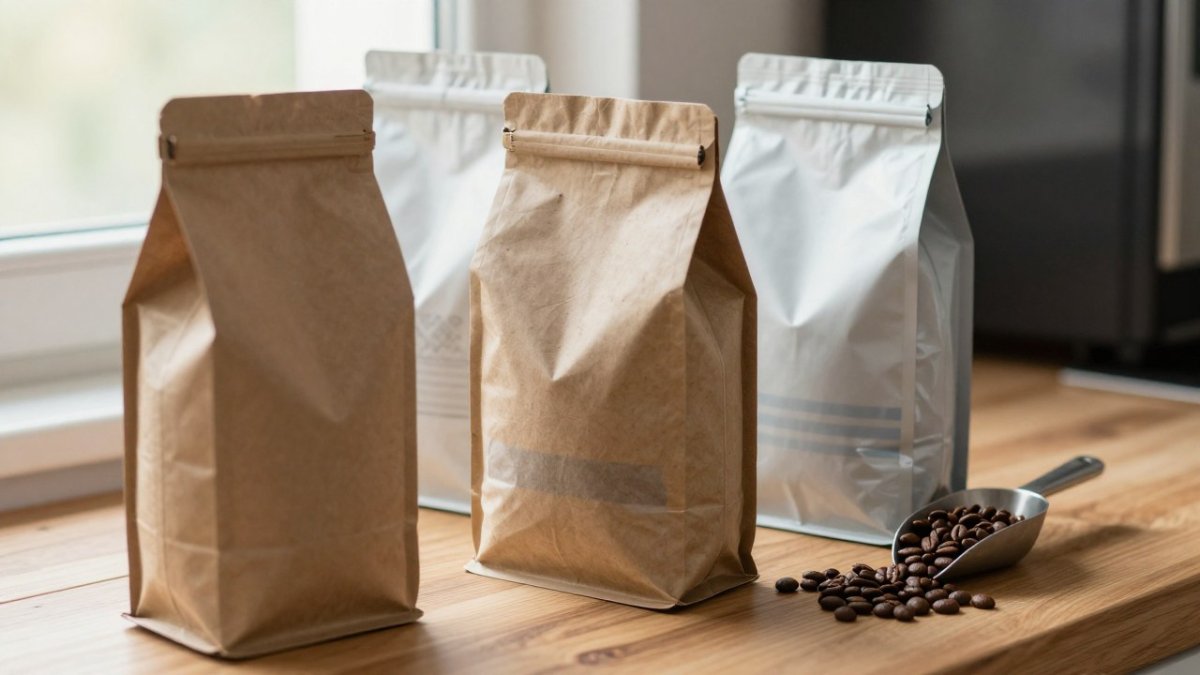
| Material | Barrier performance | End-of-life reality | Operational notes | Best for |
|---|---|---|---|---|
| Kraft paper (unlined) | Low; porous to oxygen and moisture | Widely accepted in paper streams | Cheapest per unit; poor seal integrity; needs an inner liner for any real shelf life | Short-lived, high-turnover bags |
| Recyclable mono-material | Moderate | Accepted only where film collection or store drop-off exists | Narrow seal window; may run slower on existing lines | Brands with local drop-off access |
| Compostable film | Moderate; degrades over time | Requires industrial composting; rarely accepted curbside | Heat-sensitive in storage; shorter usable window | Regions with organics collection |
| Multi-layer laminate | High; oxygen and moisture barrier | Rarely recyclable | Best runnability and seal strength; lowest unit cost at volume | Long shelf life, wholesale |
| Reusable tin or jar | High | Refill and reuse | Highest unit cost and shipping weight; needs a return or refill loop | Ritual buyers, gifting |
Reading the comparison honestly
A lifecycle view changes the ranking. Paper is often assumed to be the low-impact choice, but an unlined kraft bag that lets oxygen in can waste more resources through spoiled beans than a high-barrier laminate that protects them.
On the disposal side, the gap between "technically recyclable" and "actually recycled" is wide. Flexible films, even mono-material ones, are excluded from most curbside programs because sorters handle rigid containers more reliably. A mono-material bag only performs as recyclable when a store drop-off or dedicated film collection exists in the customer's area.
A use-case decision matrix
Instead of picking a material in the abstract, match it to how the coffee will travel:
- Local retail, fast turnover, organics collection available: compostable film is defensible because the bag is likely to reach the right stream.
- Nationwide e-commerce, months on a shelf: high-barrier laminate protects the product; pair it with a clear disposal instruction rather than an unverifiable green claim.
- Subscription with a return loop: reusable containers or tins can outperform single-use options on impact, provided the loop actually closes.
- Gift and specialty sets: small-format tins or jars reduce per-unit waste and double as packaging the customer keeps.
What most guides miss is that material choice is a systems question, not a moral one. A mono-material bag that nobody can recycle locally performs worse than a laminate that keeps beans fresh for months. A modest material its customers can actually dispose of is preferable to a premium one that ends up in landfill. The practical test is simple: if the new material shortens shelf life or has no realistic disposal path for your customers, it is not an upgrade no matter how it is labeled.
Are Compostable Coffee Bags Worth It?
Compostable coffee bags are worth it only when three conditions line up: your customers have access to industrial composting, the bag's barrier layer is thick enough to protect freshness, and you can absorb the higher unit cost. Miss any one and the environmental benefit shrinks fast. The honest limitation is infrastructure, and it is where most guides stop short.
Where compostable bags actually go
Compostable film needs specific temperature and moisture conditions to break down, which a home compost pile rarely reaches. Many compostable bags are also not accepted in municipal organics programs, so they land in general waste, where they behave much like conventional plastic.
A common pattern is that a roaster switches to compostable film, prints a compostable claim, and then discovers the local organics program does not accept it. The bag then enters the wrong stream, where it can contaminate a compost batch or simply be screened out.
The cost and operational trade-offs
Compostable film can carry a higher unit cost than conventional laminate, and minimum order quantities are a common consideration at low volumes. Beyond the bag itself, budget for the label, the valve, and any changes to seal temperature or line speed. Compostable films can need different seal settings, which may affect a packing line. Lighter bags can also change shipping costs, since carriers bill on dimensional weight as well as mass.
A simple decision test
- Choose compostable if: you sell locally, your buyers have organics collection that accepts the film, and turnover is quick.
- Skip compostable if: you ship nationwide, your customers have no composting access, or your beans sit on shelves for months.
- Consider a hybrid if: you want a lower-impact story but cannot guarantee disposal; a recyclable mono-material with a store drop-off instruction may be more honest than a compostable claim nobody can act on.
The test that matters is not whether the bag is compostable in a lab, but whether it will be composted in your customer's kitchen. If the answer is no, the claim is doing marketing work rather than environmental work.
Recyclable Coffee Packaging: What Your Local Program Accepts
Recyclable coffee packaging only works when the material matches what your local recycling program actually collects.
Dark Roast | Single-Serve Pour Over Coffee →
The practical move is to check your municipality's accepted-materials list before you commit to a bag. Many regions accept rigid containers but not flexible film, and some run separate drop-off points for soft plastics at retail locations.
Contamination is the quiet problem. Greasy, layered, or mixed-material bags can spoil a whole bale of otherwise good recyclate, which is why sorters reject them.
Sustainable Packaging Certifications You Can Verify
Sustainable packaging certifications are third-party marks that confirm a material meets a defined standard, and they are the fastest way to separate a real claim from a slogan. Look for a certification body's name and registration number, not just a leaf icon.
The marks worth knowing fall into a few families: compostability standards that verify a material breaks down under controlled conditions, recycling-content certifications that confirm how much post-consumer material a package contains, and forestry certifications that trace paper and pulp to responsibly managed sources.
Ask three questions of any badge:
- Which body issued it, and can I look it up?
- Does it cover the whole package or just one layer?
- Does it match how my customers will actually dispose of the bag?
If a supplier cannot answer all three, treat the claim as marketing. For a wider view of how ethical sourcing and certification play out across the category, see our roundup of the best ethical coffee brands in Canada, and for the farming side behind these claims,
Barrier Properties: Why Freshness Still Comes First
The trade-off is unavoidable. High-barrier laminates protect beans best and recycle worst. Compostable films protect reasonably well and degrade on a schedule that may outpace your shelf life. Paper feels honest and protects least.
This is where eco friendly coffee packaging gets genuinely hard, and where we think most brands get the priority backwards. Protect the product first, then optimize disposal.
If you want to confirm your beans survived the switch intact, our guide on how to tell if coffee is fresh walks through seven practical tests, and our piece on humidity's impact on coffee bean freshness explains why moisture control matters as much as oxygen.
How to Switch Packaging Without Losing Freshness or Margin
Switching packaging is a testing project, not a purchase order. Run it in six steps and you will catch the failures before your customers do.
- Audit your current bag. Note the layers, the valve, the seal type, and how long beans stay at their best. This is your baseline.
- Shortlist two materials. One that improves end-of-life, one that protects freshness at least as well as today.
- Order samples and fill them. Pack real beans and store them the way your customers will: cupboard, counter, fridge.
- Taste at intervals. Compare the new bag against your baseline at the same points, side by side, blind if you can.
- Check disposal locally. Confirm your municipality or drop-off network accepts the new material before you print a claim on it.
- Cost the whole change. Include the bag, the label, the valve, any new sealing equipment, and the shipping weight difference.
Two operational trade-offs catch most brands. Compostable and mono-material films often need different seal temperatures, which can slow a packing line. Lighter bags can also change shipping costs, since carriers bill on dimensional weight as well as mass.
A simple way to judge the switch: if the new bag protects freshness for the same number of weeks and your customers can dispose of it correctly, it is an upgrade. If either fails, keep testing.
Choosing Your Next Bag of Beans
The packaging debate matters because the beans inside deserve protection, and that is the part we can stand behind. Our Sumatra G1 USDA is a dark, syrupy single-origin, and our Yirgacheffe Ethiopia brings floral jasmine and bright citrus in a medium profile. If convenience is your priority, our single-serve pour over bags make a fresh cup simple.
Browse the full collection and pick the roast that fits your ritual. Taste the difference fresh beans make.
Frequently Asked Questions
What makes coffee packaging eco-friendly?
Three things decide it: the material and how much recycled content it holds, what happens to the bag after you finish the beans, and whether the packaging still protects freshness. A bag made from renewable paper that lets oxygen through will waste more coffee than a lighter laminate that keeps it fresh. Look for a clear disposal instruction on the pack and a certification you can check, rather than a leaf symbol alone.
Are compostable coffee bags better for the environment than recyclable ones?
It depends on where the bag ends up. Compostable coffee bags need industrial composting to break down in a reasonable time, and most curbside programs do not collect them. Recyclable coffee packaging only helps if your local program accepts the material and the bag is empty and clean. Neither option wins outright; the better choice is the one your local waste stream can actually handle.
Can coffee bags be recycled?
Some can, many cannot. Single-material paper bags recycle easily where paper collection exists. Multi-layer laminated bags, the kind with a foil or metallized liner, are usually not accepted because the layers cannot be separated. Check your municipality's accepted materials list before assuming. Bags labeled recyclable may still be turned away at the curb, so confirm the specific material your program takes.
Does sustainable packaging still protect coffee quality?
It can, if the barrier is right. Coffee stales from oxygen, moisture and light, so a bag needs an oxygen barrier, a moisture barrier and a one-way valve to release carbon dioxide. Paper alone offers weak protection. Ask what the barrier layer is made of before you trade freshness for a greener label.


