
Last Updated: November 4, 2026
Quick Summary
Becoming a certified Q Grader means passing the Coffee Quality Institute's exam series, which tests aroma recognition, taste identification, defect detection and blind cupping flights. There are no formal prerequisites, but you should build months of cupping practice before enrolling. Confirm the current syllabus, pass marks and retake policy with your course provider when you register.
- A Q Grader is licensed by the Coffee Quality Institute to score coffee on the standardized 100-point cupping scale.
- The most common failure is enrolling too early, usually from a lack of cupping hours rather than ability.
- Start practicing at least two months before the course with weekly blind cuppings and daily aroma kit drills.
- Ask each provider for a written fee breakdown and the retake policy before paying a deposit.
- Smaller class sizes give more cupping time per candidate, so weigh that when comparing providers.
Table of Contents
- What a Q Grader Credential Actually Certifies
- Who the Q Grader Certification Is For
- Prerequisites and Readiness Self-Assessment
- Q Grader Exam Requirements and the Exam Series
- Coffee Cupping Protocols You Must Master
- Q Grader Certification Cost in CAD and Financial Planning
- Finding and Registering for a Course
- Building Your Cupping Practice Before the Course
- Frequently Asked Questions
What a Q Grader Credential Actually Certifies
Becoming a certified Q Grader means passing the Coffee Quality Institute's exam series, and it is the credential most specialty coffee buyers, roasters and quality leads treat as the industry benchmark. This guide walks through the full pathway: eligibility, the course, the practical exams, cost planning, and how to choose a course.
A Q Grader is a coffee professional licensed by the Coffee Quality Institute to score coffee on the standardized 100-point cupping scale. The credential certifies that you can taste, describe and grade coffee consistently, the same way another licensed grader would.
That consistency is the whole point. Coffee quality assessment only works when two people tasting the same cup reach the same score.
The Role of Sensory Evaluation in Coffee Quality
Sensory evaluation is the practice of judging coffee through smell, taste and touch rather than lab equipment. It covers aroma, flavor, acidity, body, aftertaste and defects, assessed in a fixed order.
Cupping is the formal version of this. Graders slurp from a spoon, compare cups side by side, and record scores on a standard form. The Coffee Quality Institute's cupping standards set the protocol everyone trains against.
If you want to understand how the 100-point scale turns into a number on a bag, our guide to coffee cupping scores explains the grading bands.
Who the Q Grader Certification Is For
The Q Grader certification suits people whose work depends on judging coffee accurately, not hobbyists who simply enjoy a good cup. It is built for green coffee buyers, quality control staff, roasters, importers and sensory panel leads.
Barista experience helps but is not the same skill. Pulling shots teaches you extraction. Cupping teaches you to separate a defect from a flavor note.
Ask yourself three questions:
- Does my job require me to approve or reject coffee lots?
- Do I need scores that other companies will accept?
- Am I willing to train my palate for months, not days?
Two yeses is a strong signal. One yes means you probably want practice first.
Prerequisites and Readiness Self-Assessment
There are no formal prerequisites for the Q Grader course, but readiness matters more than paperwork.
Run this honest self-check before you pay a deposit:
| Readiness Check | Ready If... | Wait If... |
|---|---|---|
| Cupping experience | You have cupped 20+ sessions | You have never cupped formally |
| Defect recognition | You can name common green coffee defects | Defects all taste "bad" to you |
| Sensory vocabulary | You describe acidity, body and aftertaste separately | You only say "smooth" or "strong" |
| Smell recall | You recognize the standard aroma references | Most reference smells are unfamiliar |
| Time commitment | You can study daily for 6-8 weeks | You need to cram the week before |
Score four or more in the "ready" column and book the course. Below that, spend a few months practicing.
Watch out: the most common failure is enrolling too early. Graders who fail an exam usually lacked cupping hours, not intelligence.
Q Grader Exam Requirements and the Exam Series
The Q Grader exam requirements center on a series of practical assessments taken during the course. Passing each exam is required to earn the license, and the Coffee Quality Institute sets the official requirements.
Confirm the current syllabus with your provider when you register, since exact wording and sequencing vary by instructor and course version.
| Assessment | Skill Tested | Typical Format | Preparation Approach |
|---|---|---|---|
| Aroma recognition | Smell recall and identification | Blind smelling of reference vials from the standard aroma kit | Daily ten-minute drills with the kit; name each vial before checking the label |
| Basic taste identification | Detecting sweet, sour, salty and bitter at low concentration | Blind tasting of solutions in water | Practice with diluted solutions; learn your personal detection threshold |
| Acid and body calibration | Ranking intensity across cups | Ordering multiple cups by acid or body level | Cup the same coffee at different strengths and rank blind, then compare |
| Defect detection | Spotting green and roasted defects | Identifying defective samples in a flight | Study the standard defect reference set; cup known-defect samples |
| Organic acid matching | Matching acid types across cups | Pairing cups that share the same acid | Cup single-origin samples side by side and note acid character |
| Cupping flights | Scoring against a reference | Blind scoring of multiple flights on the standard form | Weekly blind cupping with full scores, compared against a reference the next day |
| Sensory skills | Overall palate calibration | Combined sensory exercises | Build a routine that covers aroma, taste and ranking together |
Passing requirements are set by the Coffee Quality Institute, so check the current pass marks and retake policy before you register.
Practical Exams and Assessment Format
The practical exams are hands-on. You sit at a cupping table with numbered cups and score them blind, and the instructor compares your scores against the reference.
Typical assessments include:
- Aroma recognition using the standard smell kit
- Sweet, sour, salty and bitter identification at low concentrations
- Acid and body intensity ranking across multiple cups
- Defect detection in green and roasted samples
- Organic acid matching
- Cupping flights scored against a reference
The format rewards consistency over cleverness. You are trying to reach the same score the reference grader reached, so practice the standard form until your notes are structured the same way every time.
If you want to understand how the 100-point scale turns into a number on a bag, our guide to coffee cupping scores explains the grading bands.
Coffee Cupping Protocols You Must Master
Coffee cupping protocols are the fixed steps every grader follows so scores stay comparable across labs and countries. Break the protocol and your score means nothing to a buyer.
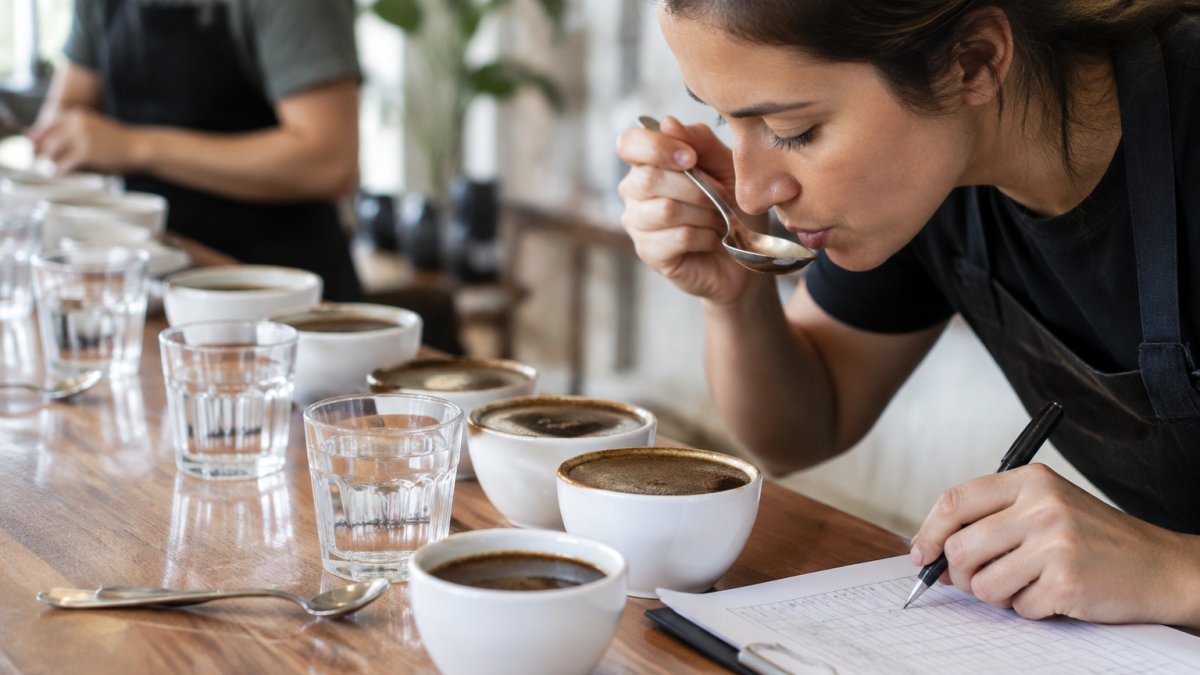
The core routine:
- Weigh a fixed dose of ground coffee into each cup.
- Pour water just off the boil and let the crust form.
- Break the crust and smell the released aroma.
- Skim the surface clean.
- Slurp from a spoon so coffee hits the whole palate.
- Score aroma, flavor, acidity, body, aftertaste and balance.
- Record defects and subtract them from the total.
Practice with varied samples. A light roast coffee bundle gives you several origins to cup side by side, which is exactly the comparison work the exams demand.

Q Grader Certification Cost in CAD and Financial Planning
Q Grader certification cost varies by provider and location, so treat any single figure with suspicion. Course fees may bundle tuition, exam sittings and materials, while travel, accommodation, practice supplies and retakes may sit outside them. The useful exercise is not finding one headline number but building a total-cost picture you can compare across providers.
Budget for these lines:
- Course and exam fee, quoted by the provider
- Travel and accommodation for six days
- Practice coffee and aroma kit
- Retake fees, if needed
- Lost work time
A practical way to plan is to separate fixed costs from variable ones. The course and exam fee is fixed once you register. Travel, lodging and meals are variable and depend on whether the course runs in your city or requires a trip. Practice supplies and retakes are contingent, but you should still set aside a buffer for at least one retake, because a single failed assessment is the most common reason candidates pay twice.
Currency matters here, since a course listed abroad may convert at the exchange rate on the day you pay. Ask each provider for a written breakdown in the currency you will actually be charged, and confirm whether taxes are included.
When comparing providers, weigh the total against what you get:
- Class size, since smaller groups give more cupping time per candidate
- Whether retakes are hosted locally, which avoids a second trip
- Language of instruction and any translation support
- Delivery format, in person or hybrid
- What materials and practice supplies are included
Watch out: do not commit a deposit before you have the written fee breakdown and the retake policy in hand, because retake scheduling and fees vary by provider and are the line most likely to surprise you.
The Coffee Quality Institute's course listings show upcoming dates and providers, and the institute lists current course fees on its site.
Finding and Registering for a Course
When comparing courses, check:
- Instructor credentials and years of Q licensing
- Class size, since smaller groups give more cupping time
- Language of instruction
- Whether retakes are hosted locally
- Delivery format, in person or hybrid
The Coffee Quality Institute's course listings show upcoming dates and providers.
Building Your Cupping Practice Before the Course
Practice before the course is the difference between passing and paying for a retake. Start at least two months out.
Build a simple weekly routine:
- Cup three coffees blind every week and write full scores
- Compare your notes against a reference score the next day
- Practice the aroma kit for ten minutes daily
- Cup with others so you calibrate against another palate
Our guide to how long it takes to learn coffee cupping gives a realistic timeline, and a global coffee collection supplies six origins for comparison work.

Taste widely. Our article on why single origin beans taste better explains how to pull apart flavor notes, which is the skill the sensory exams reward.
Frequently Asked Questions
How long does the Q Grader certification course take?
Courses combine instructor-led training with the exam series, and the schedule varies by provider. Confirm the format with your provider. Plan for additional self-study before you arrive, since the practical exams assume you already have a working palate and familiarity with coffee cupping protocols.
Do I need prior experience to become a Q Grader?
There is no formal prerequisite, but the course moves fast. Candidates often arrive with relevant coffee experience. You should be able to identify basic flavor attributes, describe acidity and body consistently, and detect common defects in green coffee. A readiness self-assessment, ideally with a practicing licensed Q Grader, will tell you whether your palate is calibrated enough to pass the exam series on the first attempt.
What is the difference between a Q Grader and a coffee taster?
A coffee taster evaluates coffee informally, often for enjoyment or internal buying decisions. A licensed Q Grader passes a standardized exam series covering sensory skills, cupping protocols, green coffee grading, and roast evaluation, and is calibrated against a shared reference standard. That credential lets you score coffee using the industry's common language, which matters for quality control, contract negotiation, and career development across the coffee value chain.
How often do I need to renew my Q Grader certification?
The credential is not permanent. Holders recalibrate on a recurring cycle, typically every three years, by completing a calibration course and passing the relevant assessments again. This keeps your palate aligned with the shared standard and confirms you can still detect defects and score consistently. Check the current renewal requirements with the certifying body before you book, since the pathway and program details have changed over time.
Becoming a certified Q Grader takes patience, practice and a palate trained on real variety. At Gilded Grind, we source beans with the range that makes that training worthwhile, from bright Yirgacheffe to deep Sumatra G1, with roast profiles from light to dark and convenient bundles for regular cupping sessions. Start with our collection and give your palate something worth studying. Get started with Gilded Grind and cup with beans that reward the effort.


