
Last Updated: October 27, 2026
Quick Summary
Water quality reshapes espresso flavor because brewing water is the solvent that carries flavor compounds out of the grounds and into your cup. Hardness, alkalinity, and TDS set the ceiling on extraction, so balanced water makes good beans taste remarkable while bad water flattens even great ones.
- Distilled or reverse osmosis water is too clean, so extraction stalls and the cup tastes flat and hollow.
- Magnesium binds to fruity, bright flavor compounds while calcium adds body and rounds out texture.
- A common working range is roughly 50-175 ppm hardness and 40-70 ppm alkalinity as calcium carbonate.
- Alkalinity above roughly 70 ppm tends to flatten acidity; below roughly 40 ppm, bright coffees can turn sharp.
- Brew the same coffee with known-good bottled or remineralized water to confirm water is the cause.
Table of Contents
- Why Water Quality Decides How Your Espresso Tastes
- What the Best Water for Espresso Actually Looks Like
- Espresso Water Hardness: The Scale Problem
- Water Alkalinity for Coffee: The Flavor Buffer
- How to Test Water for Coffee at Home
- Filtration and Remineralization: Getting From Tap to Target
- Troubleshooting Espresso Flavor Symptoms by Water
- Dialing In Your Water Before Your Next Bag
- Frequently Asked Questions
Why Water Quality Decides How Your Espresso Tastes
Water makes up most of what lands in your cup. That simple fact explains why the impact of water quality on espresso flavor is bigger than most home baristas expect.
Brewing water is the solvent that carries flavor compounds out of the coffee grounds and into your cup. (Water and the Taste of Coffee) Change the water and you change what gets extracted.
Here is the part most guides get wrong. They treat water as a background detail. In practice, it sets the ceiling on everything else. If you want to see how your improved water flatters different origins, browse our guide to the best single origin coffee beans.
What the Best Water for Espresso Actually Looks Like
The best water for espresso is clean, low in chlorine, and rich in the right minerals at the right levels. It should taste neutral on its own, with no metallic or salty edge.
Three numbers tell most of the story:
- Total dissolved solids (TDS): the overall mineral load
- Hardness: the calcium and magnesium content
- Alkalinity: the water's ability to buffer acids
Sodium and pH play supporting roles. None of these should run wild. The goal is balance, not purity.
Here is the counterintuitive part. Distilled or reverse osmosis water is too clean. With no dissolved minerals, extraction stalls and the cup tastes flat and hollow. You need some mineral content to pull flavor out of the grounds.
Espresso Water Hardness: The Scale Problem
Espresso water hardness is the measure of calcium and magnesium ions in your water. Both help extraction. Magnesium binds to fruity, bright flavor compounds. Calcium adds body and rounds out texture.
So harder water means better espresso? Not quite.
The same minerals that help your cup also build up inside your machine.
Watch out: heavy scale buildup is one of the most common causes of an espresso machine that suddenly runs hot, slow, or uneven. It is also avoidable.
The fix is a middle path. You want enough hardness for flavor, not so much that your machine suffers. Test your tap water first, then decide whether to soften, filter, or blend.
Water Alkalinity for Coffee: The Flavor Buffer
Water alkalinity for coffee controls how much acid survives into the cup (Water and Coffee Acidity). Alkalinity is the water's capacity to neutralize acid, driven mainly by bicarbonate.
This is where flavor balance lives. Too little alkalinity and bright coffees turn sharp and sour. Too much and the cup goes flat, muted, and dull, with delicate floral notes buried.
Think of alkalinity as a volume knob for acidity. Turn it down and the coffee gets brighter. Turn it up and the coffee gets softer and rounder.
The water should serve the bean, not fight it.
How to Test Water for Coffee at Home
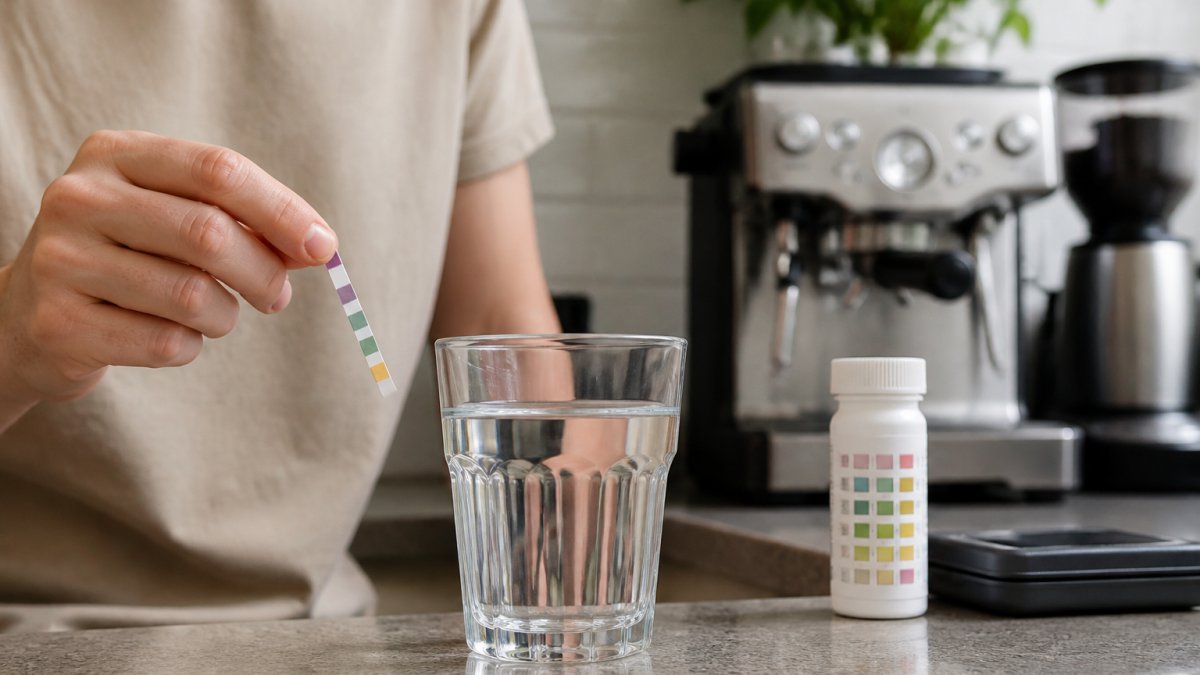
Testing water at home takes about ten minutes and a few simple tools. You can browse coffee and tea accessories like scales and measuring tools to keep your samples consistent. You do not need a lab. What matters is running the same procedure each time so your readings are comparable, then interpreting them against targets for both flavor and equipment protection.
The tools that actually earn their place
- Total hardness test strips or a drop-count kit, reads calcium and magnesium as a hardness number. Drop-count kits are slower but more precise than strips.
- Alkalinity test strips or a drop-count kit, reads bicarbonate buffering capacity. Keep this separate from hardness; they are different measurements and often get confused.
- A TDS meter, reads overall dissolved solids in parts per million (ppm). Useful as a quick sanity check, not as a substitute for hardness and alkalinity.
- pH strips, a coarse read on acidity. Most tap water sits near neutral, so pH rarely drives flavor problems on its own.
- A small digital scale and two identical glasses, for consistent sample volume and side-by-side comparison.
A repeatable testing workflow
- Collect a fresh sample. Run the cold tap for 20-30 seconds, then fill a clean glass. Water that has sat in pipes overnight can read differently.
- Test hardness first. Dip the strip or run the drop count per the kit instructions. Record the number in ppm or as grains per gallon, and note which unit your kit uses.
- Test alkalinity the same way. Record it separately.
- Check TDS. A TDS reading well above your hardness plus alkalinity readings usually signals sodium, chloride, or other dissolved content worth investigating.
- Check pH. Note anything far from neutral.
- Repeat on your filtered water. The gap between tap and filtered readings tells you what your filter is actually removing.
Reading the numbers against targets
A common working range among specialty coffee practitioners is roughly:
- Hardness: about 50-175 ppm as calcium carbonate
- Alkalinity: about 40-70 ppm as calcium carbonate
- pH: roughly 6.5-7.5
- TDS: broadly consistent with your hardness and alkalinity readings
Treat these as starting points, not laws. The lower end of hardness favors clarity and brightness; the upper end adds body but raises scale risk. Alkalinity above roughly 70 ppm tends to flatten acidity; below roughly 40 ppm, bright coffees can turn sharp. For espresso specifically, many practitioners favor the lower-middle of the hardness range because short brew ratios and high pressure concentrate both flavor and scale risk.
Interpreting results for your setup
- Hard but low alkalinity: flavor may be fine, but scale risk is high. Filter or soften, then re-test.
- Soft but high alkalinity: little scale risk, but the cup may taste flat. Consider a lower-alkalinity source or blending.
- Low everything: water is too pure and extraction will stall. Remineralize or blend.
- Readings that drift between tests: your filter is likely spent or your source is changing. Re-test monthly.
Keep a simple log: date, source, hardness, alkalinity, TDS, and pH. Patterns show up fast. If your hardness climbs over a few weeks, your filter is likely spent.
Filtration and Remineralization: Getting From Tap to Target
Filtration and remineralization are the two levers that move tap water toward a target profile. Filtration removes what you do not want. Remineralization adds back what you do.
For most homes, a carbon filter is the first step. It strips chlorine and off-flavors that make coffee taste like a swimming pool.
If your water is very hard, a softening cartridge or reverse osmosis system helps. But reverse osmosis water is nearly empty of minerals. That is where remineralization comes in.
Watch out: do not chase perfect numbers with guesswork. Change one variable at a time, taste, and adjust. Small steps beat big swings.
Troubleshooting Espresso Flavor Symptoms by Water
Most off-flavors trace back to a specific water problem, but water is rarely the only suspect. The useful skill is separating a water signal from a grind, dose, or temperature signal before you change anything. Work through symptoms in order, change one variable at a time, and taste after each change.
First, rule out the non-water variables
Before blaming water, confirm the basics:
- Grind and dose: a shot that runs far faster or slower than usual points to grind or dose, not water.
- Temperature: sudden sourness or bitterness with no change in water usually means brew temperature drifted.
- Freshness: stale grounds taste flat and papery in a way that mimics soft water.
- Basket and group head: residue and old oils produce chemical or rancid notes that water cannot fix.
A quick test: brew the same coffee with a known-good bottled or remineralized water. If the symptom disappears, water is the likely cause. If it persists, look elsewhere.
Symptom-to-cause map
| Symptom | Likely water cause | Mechanism | What to try |
|---|---|---|---|
| Sour, sharp, thin shots | Alkalinity too low | Little bicarbonate to buffer acids, so bright compounds dominate | Raise alkalinity modestly, then re-taste |
| Flat, muted, lifeless cup | Alkalinity too high | Excess buffer neutralizes acidity and buries delicate notes | Lower alkalinity or blend with lower-alkalinity water |
| Chalky, drying finish | Hardness too high | Excess calcium and magnesium leave mineral residue on the palate | Filter or soften, then re-test hardness |
| Hollow, papery taste | Water too pure | No minerals to carry extraction, so fewer compounds reach the cup | Remineralize or blend with tap water |
| Chemical, plastic, or swimming-pool note | Chlorine or contaminants | Chlorine compounds volatilize into the cup | Use a fresh carbon filter and re-test |
| Inconsistent shots day to day | Shifting water source | Changing mineral load alters extraction | Test regularly and log readings |
| Fast scale, slow flow, temperature swings | Hardness too high over time | Scale insulates boilers and narrows passages | Soften or filter, and descale per the machine manual |
Espresso-specific adjustment steps
Espresso concentrates both flavor and mineral effects because of the short brew ratio and high pressure. That means small water changes show up quickly.
- Log a baseline. Record hardness, alkalinity, and pH alongside your recipe (dose, yield, time, temperature).
- Change one water variable. If shots are sour, raise alkalinity slightly. If flat, lower it. If chalky, reduce hardness.
- Re-brew the same coffee and recipe. Hold grind, dose, and temperature constant so the water change is isolated.
- Taste and record. Note whether the symptom improved, worsened, or shifted to a new problem.
- Stop when balanced. Chasing perfect numbers usually overshoots; a cup that tastes clean and balanced is the target.
If you can describe what you taste with precision, diagnosis gets faster. Our coffee flavor wheel explained in simple terms gives you the vocabulary to name acidity, bitterness, and body, so you can separate a water problem from a grind problem.
Dialing In Your Water Before Your Next Bag
Test your supply, log the numbers, and make one change at a time. Keep your beans fresh too, so water is the only variable, see our guide on how to keep coffee beans fresh longer. Your machine will thank you, and so will your cup.
Once your water is dialed in, the next step is giving it something worth extracting. A tasting pack of whole bean Colombian coffee lets you compare flavors across beans with your new water recipe.
At Gilded Grind, we offer 100% Arabica beans from regions like Ethiopia, Colombia, and Kenya. Explore the full collection.
Frequently Asked Questions
How does water quality affect espresso flavor?
Water makes up roughly 98% of an espresso shot. Water quality is one factor to consider when thinking about espresso flavor.
What water hardness is best for espresso?
Water hardness is one factor to consider when choosing water for espresso. Test your water first so you know its hardness, then change one variable at a time.
What is the difference between water hardness and alkalinity?
Hardness measures dissolved calcium and magnesium. Alkalinity measures bicarbonate. They are separate measurements: you can have hard water with low alkalinity or soft water with high alkalinity. Test both, because fixing one does not fix the other.
Can hard water make espresso taste bitter?
Water hardness is one factor to consider when investigating bitter espresso. Test water for coffee first so you can assess its hardness.
Great espresso starts long before the grind. It starts with what comes out of your tap. Gilded Grind brings you specialty-grade, sustainably sourced beans with clear flavor notes, from the bright citrus of Yirgacheffe Ethiopia to the rich body of Huila Colombia. Pair that with water you have tested and tuned, and you have a daily ritual worth savoring. Get started with Gilded Grind and taste what happens when the water and the bean finally work together.


