
Table of Contents
- Why Specialty Coffee Tastes Different: The Core Reasons
- What Separates Specialty Coffee From Commercial Beans
- How Coffee Extraction Variables Shape Flavor
- Understanding Coffee Acidity and Body
- How to Brew Specialty Coffee at Home
- Freshness, Degassing, and Peak Flavor
- Water Quality and Its Effect on Taste
- Frequently Asked Questions
Last Updated: September 24, 2026
Why Specialty Coffee Tastes Different: The Core Reasons
Specialty coffee tastes different because of what happens long before brewing: careful growing at high altitude, selective harvesting of ripe coffee cherries, precise post-harvest processing, and a green bean that meets a strict quality standard. At Gilded Grind, we offer a curated selection of premium, nature-inspired coffee beans, and the difference shows up in the cup.
Specialty coffee is coffee that scores 80 or above on the 100-point scale used by licensed Q graders, the industry's trained sensory assessors. Commercial coffee rarely clears 70.
That gap explains almost everything you taste. Commercial beans are bred for volume and disease resistance, picked in bulk regardless of ripeness, and blended to a consistent, unremarkable middle. Specialty lots are picked selectively, processed with intent, and traced back to a single farm or washing station.
The result is a cup with actual character: fruit, florals, citrus, cocoa, depending on origin and variety.
Specialty Coffee Association cupping standards and scoring protocol
What Separates Specialty Coffee From Commercial Beans
The clearest split is selectivity. Commercial harvests strip entire branches, ripe and unripe cherries together. Specialty pickers return to the same tree several times over several weeks, taking only cherries at peak ripeness. That matters because an unripe cherry tastes vegetal and astringent, while an overripe one tastes fermented and flat. Ripe cherries carry the sugars and acids that become the flavors you actually want.
But selectivity is only the first filter. What actually separates the two categories is a chain of decisions, each with a measurable threshold.
The Grading Standard Behind the Label
Specialty coffee is defined by a score of 80 or above on the 100-point scale used by licensed Q graders, the industry's trained sensory assessors. The scale is administered under the cupping protocol published by the Specialty Coffee Association. Two things drive that score: the absence of defects and the presence of distinct, positive flavor attributes.
Green coffee is graded partly on defect count per 300-gram sample. A full defect, a black bean, a sour bean, a severe insect-damaged bean, counts as one; less severe imperfections are classified as secondary defects and counted in fractions. Specialty grade permits a very small number of full defects and no primary (category 1) defects at all. Commercial grade allows far more, which is why a commercial cup tastes muddy: the defects are literally in the sample.
The Dividing Lines That Matter
- Altitude: Higher-grown beans ripen more slowly in cooler air, developing greater density and more concentrated sugars. Dense beans also roast more evenly and hold acidity better. Most specialty lots are grown above roughly 1,200 meters, with many prized origins well above 1,500.
- Varietal: Heirloom varieties, the landrace and native cultivars found across Ethiopia, for example, carry more distinct flavor than high-yield hybrids bred for uniformity and disease resistance. Bourbon, Typica, Gesha, and Pacamara are named varieties that appear on specialty labels precisely because their cup profiles differ measurably.
- Traceability: Specialty lots identify the farm, the region, and often the exact plot or washing station. That chain of custody is what connects a flavor to a place.
- Sorting: Optical sorters and hand-picking remove the discolored, chipped, and insect-damaged beans that muddy a cup. The tighter the sort, the cleaner the flavor.
Why "Premium" on a Grocery Label Means Nothing
A common mistake is assuming "premium," "gourmet," or "artisan" on a bag means specialty. Those words are unregulated marketing terms. The score is the standard, and it is verified by trained assessors rather than a copywriter. If a bag does not name an origin, a farm, or a score, treat the label as decoration.
Specialty Coffee Association cupping standards and scoring protocol
How Coffee Extraction Variables Shape Flavor
Extraction is the process of dissolving soluble compounds from ground coffee into water. Get it right and you taste sweetness, acidity, and clarity. Get it wrong and you taste either sourness or bitterness.
Three variables do most of the work.
Grind Size, Water Temperature, and Brewing Ratio
Grind size controls how fast water reaches the coffee's interior. Fine grinds extract quickly; coarse grinds extract slowly. A grind too fine for your method over-extracts and turns bitter. Too coarse and the cup tastes weak and sour.
Water temperature should sit between 90°C and 96°C for most methods. Water that's too cool under-extracts. Boiling water scorches delicate notes.
Brewing ratio is the weight of coffee to water.
| Variable | Target Range | If Too Low | If Too High |
|---|---|---|---|
| Grind size | Medium (drip), fine (espresso) | Weak, sour cup | Bitter, harsh cup |
| Water temperature | 90-96°C | Under-extracted, flat | Scorched, sharp |
| Brewing ratio | 1:15 to 1:17 | Thin, watery | Heavy, muddled |
Coffee brewing science and extraction research
Global Coffee Collection | 6 Bags →
Understanding Coffee Acidity and Body
Acidity and body are the two descriptors that confuse newcomers most, and they are worth separating clearly before you try to taste them.
Where Brightness Ends and Bitterness Begins
Brightness and bitterness sit at opposite ends of the extraction spectrum. Under-extract and you get sharp, sour brightness without sweetness to balance it. Over-extract and you get bitterness that masks everything else. The sweet spot is a balanced cup where acidity, sweetness, and body all show up together.
How to Train Your Palate to Tell Them Apart
Most people can name a flavor they dislike but cannot say whether it came from acidity, body, or sweetness. That is a skill, not a talent, and it improves with deliberate practice. Here is a routine that works.
- Acidity: Does the sip make the sides of your tongue tingle or your mouth water? Rate it low, medium, or high.
- Body: Does it feel thin like tea, or coating like milk? Swallow and notice how long the texture lingers.
- Sweetness: Is there a honeyed or caramel note underneath the brightness, or does the cup finish sharp?
Coffee flavor attributes and sensory evaluation
How to Brew Specialty Coffee at Home
Brewing specialty coffee at home comes down to controlling four things: dose, grind, temperature, and time. A pour-over gives you the most control with the least equipment.
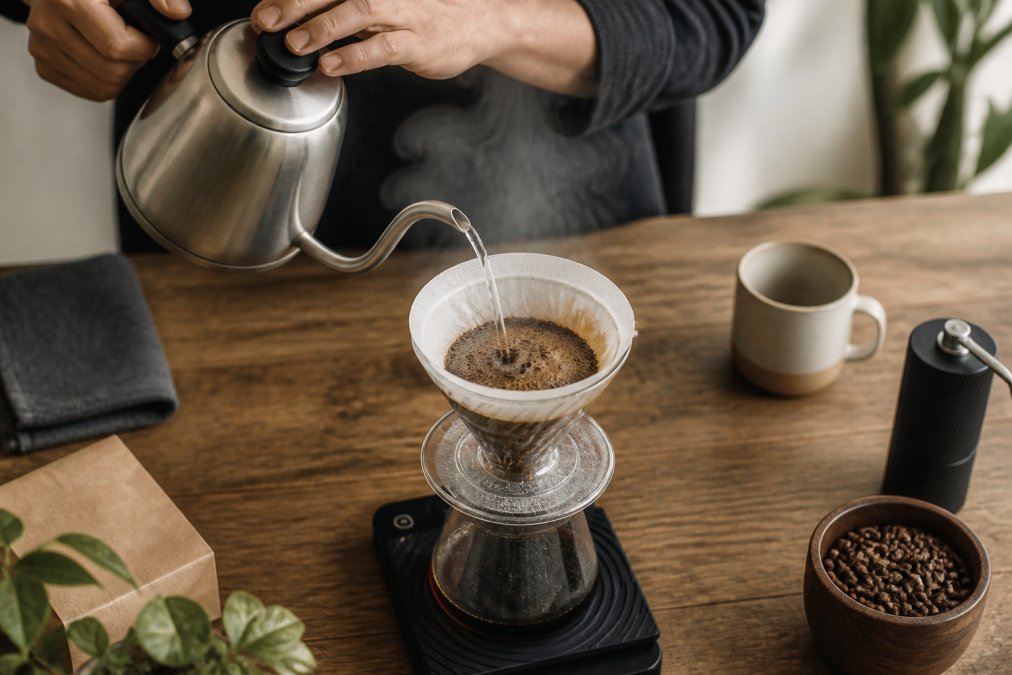
A Simple Pour-Over Routine Anyone Can Follow
Total time: about 5 minutes.
- Heat water to 93°C. Rinse the filter with hot water, then discard that water.
- Weigh 20g of coffee and grind it medium, roughly the texture of table salt.
- Start the bloom. Pour 60g of water over the grounds and wait 30-45 seconds. The bed will bubble as carbon dioxide escapes.
- Pour in stages. Add water in slow circles to reach 300g total, finishing around 2:30.
- Let it drain fully, aiming for a total brew time near 3:00.
- Taste and adjust. Sour means grind finer; bitter means grind coarser.
If you'd rather not fuss with equipment, a curated bundle takes the guesswork out of choosing. The Global Coffee Collection | 6 Bags spans six origins so you can taste how terroir changes a cup.

Freshness, Degassing, and Peak Flavor
Freshly roasted coffee releases carbon dioxide for days after roasting, a process called degassing. Brew too soon and the escaping gas disrupts extraction. Wait too long and oxidation takes over, flattening the flavors you paid for.
Signs your coffee has moved past its best:
- The aroma from the bag has gone dull
- The grounds no longer bloom when water hits them
- The cup tastes flat, papery, or stale
Water Quality and Its Effect on Taste
Water makes up more than 98% of your brewed coffee, so its mineral content shapes the cup as much as the bean does. This is the variable almost every home brewer ignores.
What to do:
- Use filtered water that still contains some minerals
- Avoid distilled water for brewing
- If your tap water tastes strongly of chlorine, a basic carbon filter solves it
- If your water is extremely hard, dilute it with a low-mineral bottled water
Water quality and its role in coffee flavor
Frequently Asked Questions
What is the difference between specialty coffee and commercial grade coffee?
Specialty coffee scores 80 or above on the 100-point cupping scale used by graders, while commercial coffee typically falls below that threshold. Specialty beans are grown at higher altitudes, picked ripe, and processed with more care, which develops clearer flavor notes. Commercial coffee often blends lower-grade beans, which can result in a less distinct flavor profile. The result is that specialty coffee tastes cleaner, more complex, and more distinct from cup to cup.
How does altitude affect the flavor profile of specialty coffee beans?
Higher altitudes slow cherry maturation, which lets sugars develop more fully and produces denser beans. That density translates into more pronounced acidity, sweetness, and layered tasting notes in the cup. Beans grown at 1,500 metres or above, like Ethiopia Yirgacheffe, tend to show floral and fruity character. Lower-altitude beans often taste flatter and less complex, which is one reason origin and terroir matter so much in specialty coffee.
What role does water quality play in the taste of specialty coffee?
Water makes up roughly 98 percent of a brewed cup, so its mineral content directly affects extraction. Too little mineral content and the coffee tastes flat; too much and it turns harsh or chalky. Aim for water with moderate hardness and a neutral pH. If your tap water smells of chlorine or tastes heavy, filtered or bottled water will let the bean's natural sweetness and acidity come through instead of being buried.
How does the brewing method change the flavor of specialty coffee?
Pour-over and drip methods highlight clarity and acidity, while immersion methods like French press build more body and mouthfeel. Espresso concentrates flavor and amplifies sweetness and bitterness at once. Whichever method you choose, grind size, water temperature, and brewing ratio matter more than the equipment itself. Adjusting one variable at a time lets you taste how each change shifts the final cup without losing track of what worked.


