
Last Updated: November 9, 2026
Quick Summary
Water chemistry shapes nearly everything you taste in home-brewed coffee, since water makes up roughly 98% of a cup. Calcium and magnesium drive extraction, and alkalinity buffers acidity, so balancing these minerals is the foundation before adjusting grind size or ratio.
- Calcium tends to bring out sweetness and body in the cup.
- Magnesium extracts more readily and can sharpen brightness and acidity.
- Test your water with a TDS meter and a carbonate hardness (KH) test.
- Aim for moderate KH, roughly 40 to 80 mg/L, for most filter coffee.
- Distilled or heavily reverse-osmosis water often produces thin, under-extracted coffee.
Table of Contents
- Why Water Chemistry Matters More Than You Think
- Understanding Water Hardness and Its Effect on Taste
- pH, Alkalinity and Minerals: What Each One Does
- Choosing the Best Water for Coffee Brewing
- How to Test Your Water at Home
- Building a Simple Coffee Water Recipe
- Your Next Step: Dialing In Your First Water Recipe
- Frequently Asked Questions
Why Water Chemistry Matters More Than You Think
Water chemistry is the part of home brewing most people never think about, yet it shapes nearly everything you taste. Water is an ingredient in its own right, because the bright, sweet notes of a good single origin can be muted or flattened by the wrong water. Water is roughly 98% of a cup of brewed coffee, so its mineral content, pH and alkalinity have a direct say in extraction and flavour.
Most guides skip straight to grind size and brew ratio. Those matter, but they cannot rescue a brew made with water that pulls the wrong compounds out of the grounds. Think of water chemistry as the foundation: get it right and every other adjustment you make has a clearer effect.
Understanding Water Hardness and Its Effect on Taste
Water hardness describes how much dissolved calcium and magnesium a water supply contains, usually expressed as milligrams per liter of calcium carbonate equivalent. It is not a single number that matters but the balance between the two minerals, because they behave differently in the brew bed.
Calcium binds to compounds in the grounds and helps pull sweet, heavy-bodied flavors into the cup. Magnesium is more aggressive: it extracts more readily and can sharpen brightness and acidity. A water that is high in magnesium but low in calcium often produces a cup that tastes lively but thin, while the reverse can taste round but dull. A total hardness in the moderate range is generally considered to give balanced extraction for filter coffee.
It also helps to know which kind of hardness you have. Temporary hardness is driven by bicarbonates and drops out when water is boiled, which is why kettles fur up. Permanent hardness is bound to sulfates and chlorides and stays in solution. For brewing, the temporary fraction matters most because it is the same bicarbonate that buffers acidity, so a hard water supply can be simultaneously good for body and bad for brightness.
A practical way to think about it: if your coffee tastes hollow even with good beans, your water may be too soft. If it tastes harsh, muddy or leaves scale on your kettle and dripper, it may be too hard. Light, floral single origins are often the first to reveal these differences, because their delicate acidity is the easiest thing for excess bicarbonate to flatten.
Watch out: hardness test strips sold for aquarium or appliance use often report in grains per gallon or in a different scale than brewing references, so convert before you compare your reading to any target range.
If you want to read more about how water quality shapes espresso specifically, our guide on water quality and espresso flavor explores the subject in depth.
The table below sums up how calcium and magnesium shape the cup, based on the points made in this section.
| Mineral | Typical effect in the cup | Watch for |
|---|---|---|
| Calcium | Sweet, heavy-bodied flavours | Hollow taste if water is too soft |
| Magnesium | Brighter, more aggressive extraction | Thin, lively cup if it outweighs calcium |
| Temporary hardness | Drops out on boiling; buffers acidity | Kettle scale and flattened brightness |
| Permanent hardness | Stays in solution after boiling | Harder to remove by boiling |
| Total hardness | Moderate range gives balanced extraction | Measure in mg/L as calcium carbonate |
pH, Alkalinity and Minerals: What Each One Does
pH measures how acidic or basic water is on a scale from 0 to 14. Alkalinity is the water's capacity to neutralise acids, and it is largely driven by bicarbonate. Minerals, mainly calcium, magnesium and bicarbonate, carry the flavour signal through extraction. These three properties interact, so adjusting one often shifts the others.
Calcium and Magnesium in Brewing Water
Calcium and magnesium are the minerals that most directly affect how coffee extracts. Calcium tends to bring out sweetness and body, while magnesium can contribute a cleaner, brighter character. A balanced amount of both helps the brew taste rounded rather than thin, and removing them entirely through very aggressive filtration is one common reason home brews taste empty.
Why Alkalinity Matters for Extraction
Alkalinity buffers the acids naturally present in coffee. Too little buffering and the cup can taste sharp and sour; too much and it can taste flat and dull, as the water neutralises the desirable acids that give coffee its brightness. Many brewers aim for a moderate level, enough to soften acidity without muting the origin character you paid for.
Choosing the Best Water for Coffee Brewing
The best water for coffee is clean, free of chlorine, and has a moderate mineral content. Filtered tap water is a good starting point for most home brewers, and bottled water can work if its mineral profile suits brewing. Distilled or heavily reverse-osmosis-treated water usually lacks the minerals needed for good extraction, so it tends to produce thin, under-extracted coffee.
If you want to read more about how water quality shapes espresso specifically, our guide on water quality and espresso flavor explores the subject in depth.
How to Test Your Water at Home
Testing your water is the fastest way to stop guessing, but the reading only helps if you know what to do with it. You can also weigh your test samples and recipe ingredients precisely with a calibrated digital scale before you begin. Start with your municipal water report, if your utility publishes one, which lists the mineral content of your supply. That report gives you the mineral baseline for free; a home test kit then tells you what actually reaches your tap after your building's pipes and any softener.
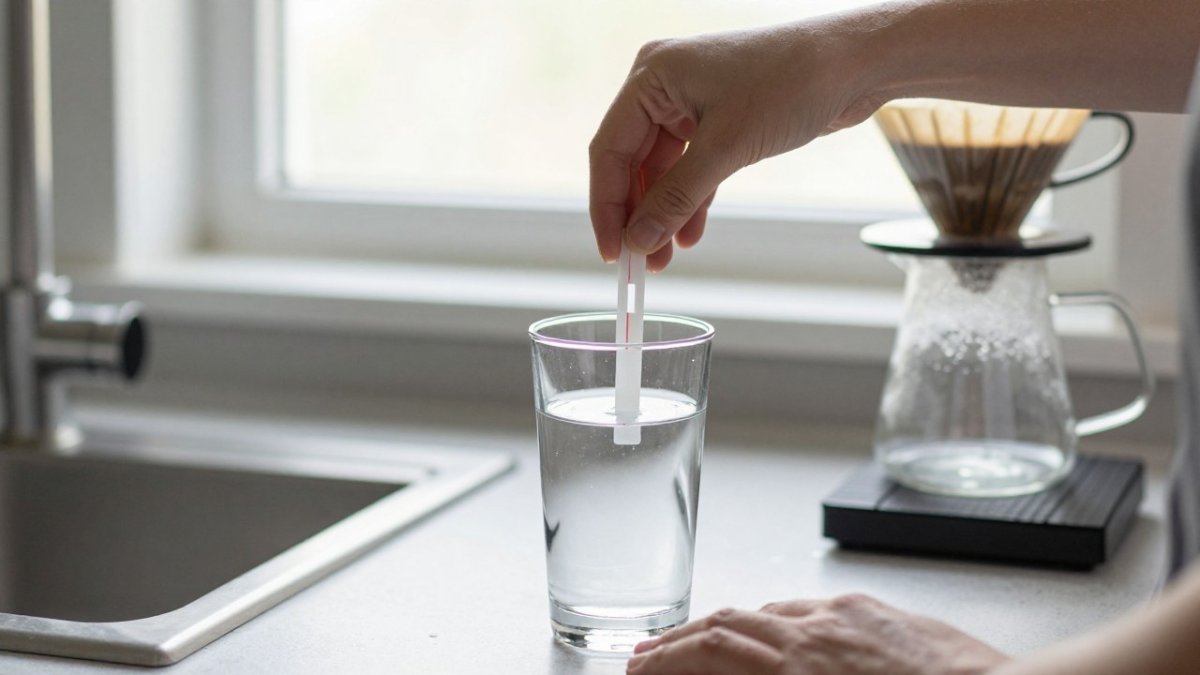
For home testing, two instruments cover most of what a brewer needs. A total dissolved solids (TDS) meter gives a quick conductivity reading in parts per million, useful for spotting changes and for checking that a filter is still working. A carbonate hardness (KH) test, borrowed from the aquarium hobby, measures bicarbonate alkalinity directly and is the single most useful number for coffee, because alkalinity is what flattens acidity. General hardness (GH) tests measure calcium and magnesium together. Test strips are coarser than liquid drop tests, which read more precisely.
Here is a simple interpretation framework you can apply the same afternoon you test:
- Low KH (under about 40 mg/L as calcium carbonate): your water has little buffering, so bright coffees may taste sharp or sour. Consider a small mineral addition rather than more filtering.
- Moderate KH (roughly 40 to 80 mg/L): a workable band for most filter coffee. Leave it alone unless a specific coffee tastes flat.
- High KH (above about 100 mg/L): expect muted acidity and a chalky finish. Dilute with low-mineral water or treat with reverse osmosis before adding minerals back.
- High TDS with low KH: often means sodium or sulfate is carrying the reading, which changes the fix entirely.
Test your tap water first, then compare it against your filtered water using the same coffee and the same brew method. Note how each one tastes. This simple side-by-side reveals more than any chart can, because your palate is the final arbiter of whether a number is working for you.
Close-up of hands dipping a water test strip into a clear glass of tap water on a kitchen counter beside a pour-over setup.
Building a Simple Coffee Water Recipe
A simple water recipe starts with your baseline. If your tap water is very soft, consider adding a small amount of mineral supplement designed for brewing; if it is very hard, filtering it partially can help. Change one variable at a time and brew the same coffee each time so you can judge the difference fairly.
Keep notes. Write down the water source, any treatment, and how the cup tastes. Over a few weeks, you will build a personal recipe that brings out the character of each origin you buy.
Your Next Step: Dialing In Your First Water Recipe
Once you know your baseline, the next step is to settle on one recipe and refine it. Our pour over coffee guide for beginners walks through the brewing steps where your water recipe will show its effect most clearly.
Gilded Grind's curated single origins, from the bright notes of Yirgacheffe to the deep richness of Sumatra G1, are designed for careful brewing. Explore the full range at the Gilded Grind collection and take your first water recipe for a test drive.
Frequently Asked Questions
What water is best for brewing coffee at home?
Water with moderate hardness and a neutral pH tends to produce the most balanced cups. Many home brewers start with filtered tap water, because filtration removes chlorine and some off-flavours while leaving enough minerals to extract sweetness and body. Distilled water is usually too soft to brew well on its own, and it can taste flat. Testing your local water is the most reliable way to know where you stand, and a simple test kit will show whether your water needs filtering or mineral adjustment before you change anything else in your routine.
How does water hardness affect coffee taste?
Water hardness reflects the amount of dissolved calcium and magnesium. These minerals help pull flavour compounds out of the grounds during brewing, so very soft water often produces a thin, sour or flat cup. Very hard water can leave a chalky, muted taste and can scale your equipment over time. Moderate hardness gives a fuller body and a clearer sweetness. Adjusting hardness is one of the easiest ways to change how a coffee tastes without buying different beans.
Can tap water be used to brew coffee?
Yes, tap water is the starting point for most home brewers, but it is not always ideal as it comes out of the tap. Chlorine can add a medicinal taste, and some municipal supplies are very soft or very hard. A carbon filter removes chlorine and many off-flavours. Check your local water report if your utility publishes one, then run a basic test to see whether hardness or alkalinity is outside the range that suits your brewing method.
Should you use filtered or distilled water for coffee?
Filtered water is generally the better choice for everyday brewing. Distilled water contains almost no minerals, so it extracts coffee poorly and can produce a flat, acidic cup. Filtration, particularly with a carbon filter, keeps some of the natural minerals while removing chlorine and unpleasant tastes. If your tap water is already very soft, you may need to add a small amount of mineral to a filtered or distilled base to bring it into a workable range.
How can you test the mineral content of brewing water?
You can test brewing water with a simple hardness test strip or drop-based kit, which gives a general reading of total hardness in parts per million. For more detail, a laboratory or a more advanced kit can measure calcium, magnesium, alkalinity and pH. Start by testing the water you actually brew with, since it may differ from the water you drink. Record the results so you can compare them later when you adjust your recipe.
How do you adjust water for better-tasting coffee?
Adjust water in small steps and change only one variable at a time. If your water tastes flat, add a small amount of mineral, such as a brewing salt, and taste the result. If the cup tastes harsh or sour, you may need to reduce acidity or raise alkalinity slightly. Keep notes on each change, including the brew method and the coffee you used, so you can repeat the results that work. A basic recipe that you adjust gradually is more useful than a complex formula you never repeat.


